Feeds:
Posts
Comments

Replay

“Replay” (1986) by Ken Grimwood is a time travel book where the hero keeps going back in time and reliving his life. But not forever: each replay is shorter than the one before. In 2003 it was #19 on the Internet Top 100 SF/Fantasy List.

Although cast as a time travel novel, it turns out to be a story about love and loss and life.

We make too big of a deal over what could have been, over how we have screwed up, and not enough of a deal of loving those we love, here and now, while they and we are still here. With time comes wisdom but wisdom always comes after you need it.

Our story: At 1.06pm on October 18th 1988 in New York, Jeff Winston, age 43, has a heart attack. The next thing he knows he is back at university in 1963. He is in his 18-year-old body but still has his 43-year-old mind, complete with all its memories and experience. He is able to get rich by betting on horses, baseball, and stocks, but cannot prevent the death of President Kennedy – or his own death.

In all his replays he always dies at 1.06pm on Tuesday October 18th 1988 no matter what. And when he goes back in time, he goes back a few months later. And then a few years later: 1968, 1976, 1985, 1988. Each time he gets less time and is less able to change things for the better.

No matter what he does, each time there is loss and regret. Unlike in “Groundhog Day” (1993), loss is an inextricable part of life. He becomes rich, but then loses his daughter. He lives for sex and drugs and jazz and self, but then gets sick of living. He tries to help the CIA change history for the better, but then they kidnap him and, with their Machiavellian logic, wind up changing history for the worst. And so on.

He feels extremely lonely: no one understands what he going through. Solzhenitsyn in exile comes the closest.

But then one day in the third 1974 he lives through, he sees a movie poster: “Starsea”. It is the work of George Lucas, Steven Spielberg, and someone he has never heard of: Pamela Phillips. He knows the film was not there in the first two 1974s: it is a huge hit, bigger than “Jaws” or “Star Wars”, and he knows enough about Spielberg and Lucas to know that they never worked on such a film. And who is Pamela Phillips?

He goes to meet her. She is another replayer….

Jeff Winston does not know why he keeps getting thrown back in time, but then neither does he know why he was born in the first place. Both are miracles. After having lived 173 years, he discovers that life is too short no matter how long it is.

Grimwood quotes Blake:

To see a World in a Grain of Sand
And a Heaven in a Wild Flower
Hold Infinity in the palm of your hand
And Eternity in an hour

– Abagond, 2018.

See also:

514

George H.W. Bush

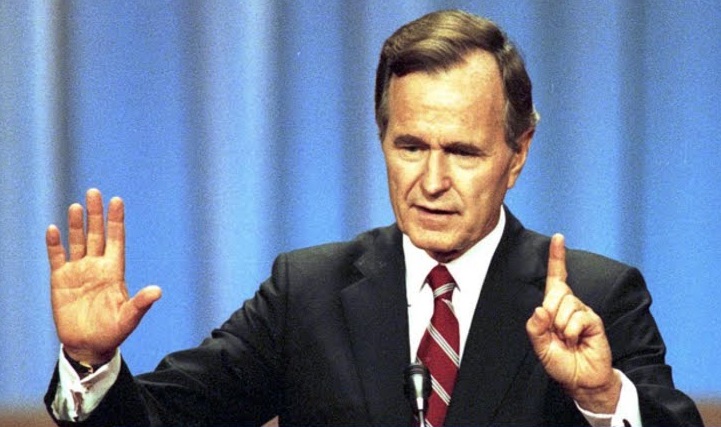
Bush in 1988.

George Herbert Walker Bush (1924-2018) was the US president from 1989 to 1993. His son was George W. Bush, whose time as president, from 2001 to 2009, was twice as long and much more destructive. Another son, Jeb Bush, also wants to be president.

Also known as: Bush Sr, Bush the Elder, Bush I, Poppy, and, as the 41st president, Bush 41. Back in the 1990s he was just called George Bush.

Houston oilman: After being the son of a senator and Wall Street banker, a student at Yale, and a pilot in the Second World War, Bush moved to Texas and made his fortune as a Houston oilman. He was an oilman to the end. He not only fought to keep Iraq from taking over oil fields of the Persian Gulf, but he undermined attempts to fight global warming, to make the air clean, and to come up with renewable energy. Scientists knew about global warming back then. In fact Bush had the Congressional testimony of one them changed to play it down.

Willie Horton.

Fear-mongerer: As a rich White oilman he was quite fine with the way the US was going. All he had to offer ordinary White people was fear. He started with Willie Horton, a Black man whose crimes he played up to get elected, playing on the racist fears of White people. It was a classic move straight out of the racist Southern Strategy playbook. He got 63% of the White male vote. Then as president he moved onto Noriega of Panama and Saddam Hussein of Iraq, demonizing them and invading their countries. Yet Bush’s first state guest at the White House was Mobutu of Zaire, a monster by any measure. And Bush only seemed to have nice things to say about Ceauşescu of Romania – until his own people overthrew him.

Saddam Hussein was no angel, to be sure, but he was not the one who bombed Iraq back to the 1800s, leading to the deaths of 55,000 children, going above and beyond any military necessity.

Unlike his son, Bush at least had the good sense not to march on Baghdad, rightfully fearing a quagmire.

Moral leadership: Bush expected people in the US to be so concerned about the sovereignty of Kuwait when Saddam Hussein invaded it that they would willingly give the lives of their own sons and daughters – and yet turn a blind eye when Bush himself invaded Panama.

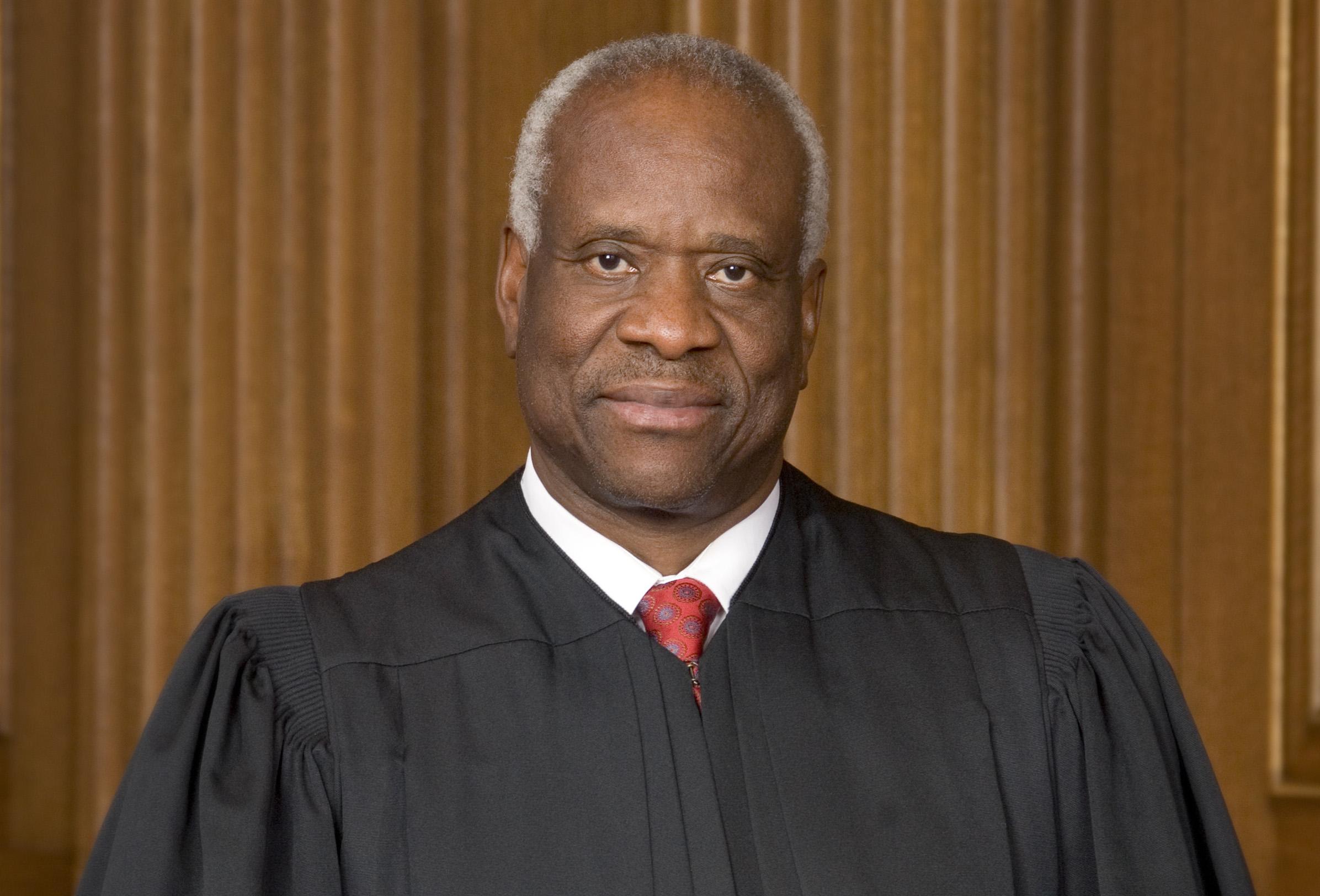
Black people: He raised money for the United Negro College Fund, yet as president he pushed the War on Drugs and the building of prisons, leading to the mass incarceration of Black men. He voted for the Fair Housing Act of 1968 as a Houston Congressman, yet opposed the Civil Rights Acts of 1964 (the famous one) and 1990. But worst of all, he put Clarence Thomas on the Supreme Court, an Uncle Tom and known opponent of affirmative action. In 2013 Thomas helped to gut the Voting Rights Act of 1965 that Martin Luther King Jr marched for. Bush is dead but his legacy lives on.

Clarence Thomas, still breathing.

– Abagond, 2018.

See also:

567

In memoriam: Tumblr

Tumblr (2007-2018) will be banning porn as of December 17th. After that date there will still be a website called Tumblr, but it will not be the same Tumblr. Not even close. It will in effect become a poor man’s Instagram, a ghost town, a den of neo-Nazis, a place where social justice warriors once roamed. The lack of heavy-handed censorship was part of what made it great. It was very much a Millennial New Yorker project. But it was already starting to go downhill.

For much of 2018 Tumblr has been fighting off porn bots, fake accounts spewing porn. Tumblr’s filtering algorithms were no match.

By the end of November it got so bad that Apple dropped Tumblr from its App Store because Tumblr was unable to keep out child porn.

Yesterday, December 3rd, Tumblr said it would ban all porn starting on the 17th. But its filtering algorithms are so bad that they cannot tell the difference between Beyonce with clothes on and a woman with clothes off. Or between the Scourging of Jesus and BDSM porn. By the time they right their ship, if they ever do, it seems that most of their users will be gone. With Judgement Day still two weeks off, people are already leaving in droves.

Tumblr’s definition of porn is any photograph or photo-realistic picture that shows sex acts, human genitals or “female-presenting nipples”. Users have been begging them to kick off neo-Nazis, but Tumblr drew the line instead at nipples.

It is pretty much the same definition of “adult content” that US television uses, but unlike television, Tumblr content is produced at such a rapid rate that human censors cannot possibly keep up – so most of it falls to inept computer algorithms.

What surprises me is that the crackdown took as long as it did. In 2013 Tumblr was bought by Yahoo! (whose ads were jarringly out of place). In 2017 Yahoo! in turn was bought by Verizon, fka Bell Atlantic.

Requiescat in pace. 

See also:

Marc Lamont Hill’s speech on Palestine (November 28th 2018) was delivered last week at the United Nations. A day later CNN fired him as a talking head. Temple University wants to fire him too, but Hill is a tenured professor.

The UN speech: Hill, after giving examples of how Israel, with US support, abuses human rights, called for solidarity with Palestinians:

Yes to BDS:

“Solidarity from the international community demands that we embrace boycotts, divestment, and sanctions [BDS] as a critical means by which to hold Israel accountable for its treatment of Palestinian people.”

The silence of the left:

“Solidarity demands that we no longer allow politicians or political parties to remain silent on the question of Palestine. We can no longer in particular allow the political left to remain radical or even progressive on every issue from the environment to war to the economy, to remain progressive on every issue except for Palestine.”

Palestinians, like Blacks, have a right to defend themselves and fight back:

“Contrary to Western mythology, Black resistance to American apartheid did not come purely through Gandhi and nonviolence. Rather, slave revolts and self-defence and tactics otherwise divergent from Dr. King or Mahatma Gandhi were equally important to preserving safety and attaining freedom. …

“If we are standing in solidarity with the Palestinian people, we must recognize the right of an occupied people to defend itself. We must prioritize peace. But we must not romanticize or fetishize it.

“We must advocate and promote nonviolence at every opportunity, but we cannot endorse a narrow politics of respectability that shames Palestinians for resisting, for refusing to do nothing in the face of state violence and ethnic cleansing.”

The NYPD and IDF, Blacks and Palestinians:

“We brought a delegation of black activists to Palestine, and we saw the connections between the police in New York City, who are being trained by Israeli soldiers, and the type of policing we were experiencing in New York City.”

Conclusion:

“we have an opportunity to not just offer solidarity in words but to commit to political action, grassroots action, local action, and international action that will give us what justice requires. And that is a free Palestine from the river to the sea.”

The ADL, which fights anti-Jewish prejudice, twisted all of that to mean:

“Those calling for ‘from the river to the sea’ are calling for an end to the State of Israel. … [Hill is promoting] divisive and destructive action against Israel.”

Hamas does use the phrase “from the river to the sea”, but it no longer calls for the destruction of Israel. And besides, Hill is not part of Hamas.

CNN fired Hill the next day. It is apparently a handmaiden of Zionist propaganda.

Temple University’s board chairman, Patrick O’Connor, a wannabe handmaiden:

“I’m not happy. The board’s not happy. The administration’s not happy. People wanted to fire him right away. We’re going to look at what remedies we have… Free speech is one thing. Hate speech is entirely different.”

– Abagond, 2018.

Sources: Google Images (picture), YouTube (the speech itself, 22 minutes), Jadaliyya (full text of speech)  Philadelphia Inquirer (O’Connor quote), Jewish Journal (ADL quote).

See also:

584

Remarks:

This went to #2 in the US on  the R&B chart in 1972. Like “Always” (1987) by Atlantic Starr, it seems schmaltzy, but I like it anyway.

I thought this song would date badly: an over-the-top love song sung in falsetto in a 1970s style. I thought it would become as unlistenable by the 2000s as, say, Frank Sinatra was to me in the 1970s. What I did not know was that when you really like a song, it never seems dated. It always seems as brand new as the day you first heard it.

See also:

Lyrics:

There’s a spark of magic in your eyes
Candyland appears each time you smile
Never thought that fairy tales came true
But they come true when I’m near you
You’re a genie in disguise
Full of wonder and surprise

And betcha by golly, wow
You’re the one that I’ve been waiting for forever
And ever will my love for you keep growin’ strong
Keep growin’ strong

If I could I’d catch a falling star
To shine on you so I’ll know where you are
Order rainbows in your favorite shade
To show I love you, thinking of you
Write your name across the sky
Anything you ask I’ll try, `cause

Betcha by golly, wow
You’re the one that I’ve been waiting for forever
And ever will my love for you keep growin’ strong
Keep growin’ strong

Betcha by golly, wow
You’re the one that I’ve been waiting for forever
And ever will my love for you keep growin’ strong
Keep growin’ strong

Betcha by golly, wow
You’re the one that I’ve been waiting for forever
And ever will my love for you

Source: AZ Lyrics.

E.J. Bradford, Jr

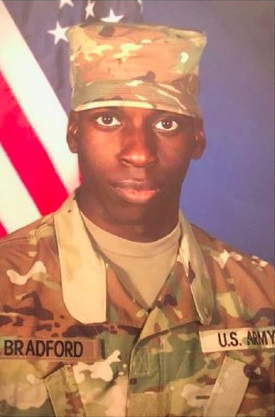
His Army photo, the picture his mother clutched in the days after his death.

Emantic “E.J.” Fitzgerald Bradford, Jr (1997?-2018), a Black good guy with a gun, was gunned down by police on November 22nd 2018, Thanksgiving night, at the Riverchase Galleria mall in Hoover, Alabama. He was trying to save people from a shooter – but all police seemed to see was a Black man with a gun – and gunned him down instead.

Like he was some wild dog:

  • They did not give him orders to drop his gun.
  • They did not give him medical attention.
  • They refused help from a nurse who was at the scene.
  • They did not cover his body.
  • They did not tell his parents.

Very much like Ferguson. And very unlike, say, Dylann Roof, a White bad guy with a gun. Roof was not just taken alive, he was taken to eat at Burger King.

Bradford’s mother:

“I did not want to see pictures of my son laying in a pool of blood and when I accidentally came across it [on the Internet] I broke down. And I can’t get it out of my head. I cannot get the scene out of my head of my child laying there, nobody around him trying to help him, just laying like a piece of trash where everyone can walk around and parade and post pictures of him on social media.”

His father, a retired police officer, called the police that night to find out if it was his son who was killed. They said they would call him back later. Hours passed with no call. He called again. They said they could not tell him anything. But then about 15 minutes later they blasted his son’s picture and name across the news and the Internet, labelling him the mall shooter.

The police did not even wait to go through all the video they had – from body cameras, mall security cameras, and mobile phones. But 17 hours later, presumably after going through the video, they said it was “unlikely” Bradford was the gunman. The real gunman was still at large.

And even then the police still did not call or visit his family.

Bradford had no police record. The oldest son, he worked full-time to help support his mother and was caretaker to his father, who is battling cancer. He was in the Army and was honourably discharged. He had a concealed weapons permit. And Alabama is an open-carry state.

His family wants all the video to be made public. The NAACP wants that and for the FBI to take over the investigation. Currently it is in the hands of the state of Alabama.

Hoover is a White-flight suburb of Birmingham, named after William Hoover, a neo-Nazi. It is a place where the Klan passes out fliers, where teachers use the N-word, where the police are known for stopping Black motorists. Birmingham is 72% Black, Hoover is 72% White.

In 2014, the Hoover police received special training from the FBI and the Department of Homeland Security on how do deal with an active shooter – at the Riverchase Galleria mall.

– Abagond, 2018.

See also:

573

Democracy Now!

“Democracy Now!” (1996- ) of Pacifica Radio is a left-wing, US-based news broadcast that comes out every weekday morning from the Chelsea part of Manhattan. It is sent over radio, television, and the Internet. Amy Goodman, sometimes with help from Juan Gonzalez and Nermeen Shaikh, wryly deadpans her way through the headlines and top issues of the day.

NPR: Some NPR radio stations carry it, but, according to journalism professor Michael V. Marcotte, most NPR stations see it as:

“a soapbox for left-facing causes, and it fails to adhere to NPR standards of journalism. It also sounds like it is produced on the fly with very poor production values.”

NPR values neutrality, aka the centre-left views of upper-middle-class bicoastal Whites.

“Democracy Now!” comes off like it is still 1971: Not just Amy Goodman’s hair and make-up (or lack thereof), but even her choice of news stories and themes: US imperialism (against), the environment (for), and minority rights (for). Instead of Vietnam, it is Yemen. Instead of pollution, it is global warming. Etc. The show adores street protests the same way the 11 o’clock news adores fires and the arrests of Black men.

Fact check: It reports news in a fact-based way. Sometimes things are carefully worded, but its facts are generally trustworthy. It has not steered me wrong yet. Media Bias/Fact Check rates it as HIGH – as good as any big-city newspaper and better than CNN.

Political bias: Unashamedly to the left of the Democratic Party, as can be seen from its frequent guests: Noam Chomsky, Ralph Nader, William Barber, Cornel West, etc. It is a place where left-wing mononyms, like Mumia and Lula, can feel at home. The left is seen as the champion of truth, justice, and equality, the right as the champion of wealth, power, and corruption. Therefore the truth is not a he-said-she-said average between the two. Unlike much of the press, they are not content with mouthing the words of police chiefs or Israeli officials.

Breadth: It covers a broader range than mainstream news – they have been covering war in Yemen and global warming all along, not just when it is the flavour of the week. But they are still clearly US-centric, generally tracking US foreign policy. They cover Black and Native American news stories that fit their themes of protest and equal rights.

Format: Like “PBS NewsHour”, it starts with about ten minutes of headline news followed by panel discussions and interviews of 10 to 15 minutes each. That allows it to get beyond the sound bites. Unlike PBS, its panellists are generally further to the left and less likely to be White men in suits. They are also way more likely to talk to actual protesters.

Funding: It does not run ads or take money from governments or corporations, but it does gladly accept donations from its audience.

Cringeworthy tropes: They do that thing where they never show the dead bodies of White people, but will show those of Black people – and fuzz out those of Brown people.

– Abagond, 2018.

Sources: The Mike Marcotte quote, Media Bias/Fact Check, RationalWiki, Democracy Now!

See also:

560

Cindy Hyde-Smith

Cindy Hyde-Smith (1959- ), a Trump Republican, has been a US Senator for the state of Mississippi since March 2018, when she was appointed by the governor. On November 27th 2018 she faces Democrat Mike Espy in a run-off election, the last of the 2018 midterm season.

If Hyde-Smith wins she will be Mississippi’s first elected White woman senator ever.

If Espy wins he will be Mississippi’s first Black senator since 1881 when Blanche Bruce left office. Espy needs a heavy Black turnout and at least 20% of the White vote. In 2014 at the last midterm, 17% of Whites voted Democratic.

Mississippi is about two-thirds White and one-third Black. Trump carried the state by 18 percentage points in 2016, but FiveThirtyEight, Nate Silver’s outfit, is unwilling to call the run-off election. There has not been enough non-partisan polling on it.

Hyde-Smith has backed Trump 100% in her Senate votes. She is for gun rights, against abortion, and for Trump’s Border Wall. From 2012 to 2018 she was Mississippi’s Commissioner of Agriculture and Commerce, an elected position she won twice.

She says she is not racist but:

  • Segregation academies: Both she and her daughter went to segregation academies. Her daughter went to Brookhaven Academy. The town of Brookhaven is 55% Black. Brookhaven Academy has one Black student out of 392.
  • “Mississippi history at its best!”: In 2014 Hyde-Smith, while agricultural commissioner, visited Jefferson Davis Home and Presidential Library in Biloxi. She posed with a Confederate hat and gun (pictured above) and said:

    “This is a must see. Currently on display are artifacts connected to the daily life of the Confederate Soldier including weapons. Mississippi history at its best!”

  • Voter suppression: In 2018 she said of voter rights:

    “And then they remind me that there’s a lot of liberal folks in those other schools who maybe we don’t want to vote. Maybe we want to make it just a little more difficult. And I think that’s a great idea.”

  • Public hangings: Also in 2018, she said of a supporter, to (White) laughter and applause:

    “If he invited me to a public hanging, I’d be on the front row.”

She said the last two comments were jokes. Ha ha. Walmart, Major League Baseball, AT&T, Pfizer, and others were not amused by the last one. They want their campaign donations back. Walmart said the remark did not reflect their values.

Historical context:

  • Lynching: From 1877 to 1950, Mississippi led the nation in lynchings, ahem, “public hangings”. And that does not even count Emmett Till.
  • Voting rights: In 1890, Mississippi led the nation by becoming the first state to put in place poll taxes and literacy tests, making it “a little more difficult” for Blacks (and poor Whites) to vote. It is a state where at least 63 people died fighting for the right to vote, Medgar Evers among them.
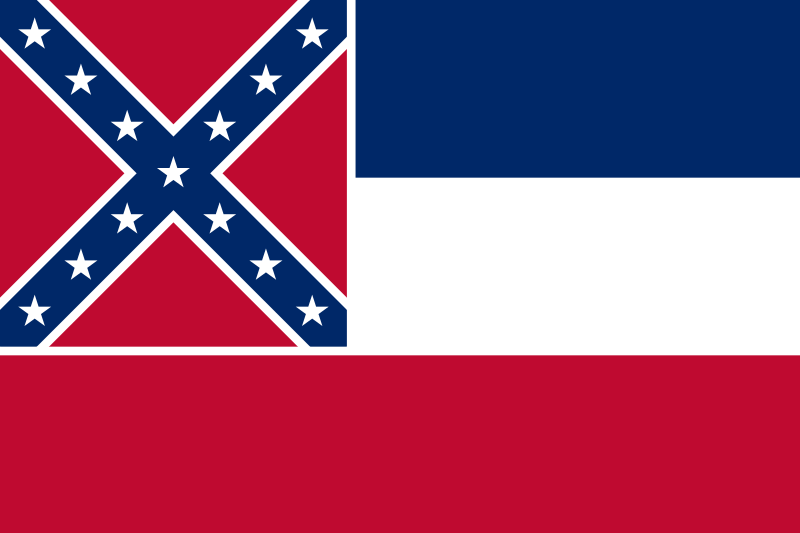
  • State flag: In 2018 Mississippi is the only state to still have the Confederate battle flag as part of its flag:

Oh, and:

  • The Southern Strategy: Since the 1960s Republicans have used racist dog whistles – plausibly deniable racist statements – to appeal to the White working class.

– Abagond, 2018.

Update (November 28th): Cindy Hyde-Smith won by 8 percentage points. A terrible showing for such a deeply red state, but not enough to cost her her seat.

See also:

553

Loleatta Holloway: Cry to me

Remarks:

They don’t make songs like this anymore – and this one only made it to #10 in 1975 on the US R&B chart. I swear I have heard it sampled somewhere, but I cannot place it. That would not be surprising: In 2011 The Independent says she was “undoubtedly the most sampled female voice in popular music.” In fact, she appeared in this space before as sampled on “Ride on Time” (1989) by Black Box.

See also:

Lyrics:

Baby, i see you packing
But it’s no surprise for me
You see, i knew it was coming for a long time
Say what ? no, no i won’t cry
You see i’m a big girl now, and i just can’t cry no more
But there’s something i want you to know:
That i love you, i love you, i love you !
And there’s one more thing i want you to know:
That if you ever need a friend
You can count on me
And honey:

If you’re falling down
And you can’t seem to stay on the ground
And when friends get few
I’ll be there to get you up
And if she puts you down
I’ll be around, so don’t be afraid
Cause i’ll be there to get you up
And if it steal the smiles, rain and shine
If you’re sad or glad, happy or bad
You can cry to me (cry to me)
Cry to me (cry to me)
No matter how harder things got to be
You can cry to me
Cry cry cry cry to me
Now i know i must sound
Just like a fool man love
But i can’t help myself really comes to loving you baby
And i know you said
That our love was true
But if it “don’t” work out
Honey here’s what i want you to do
Dial my number
Knock on the door
Write me a letter
But just let me know
Cause you can cry to me (cry to me)
Honey cry to me (cry to me)
No matter how harder things got to be
You can cry to me (cry to me)
Oh yes you can cry, oh oh oh oh oh
Oh baby, oooh baby how i’m gonna miss you …
Cause we’ve been together for so long
But i know it’s gonna be hard to live without you
But i want you to know that
When times get harder you can dial my number
Knock on my door
Honey send me a telegram
But just let, just let me know
You can cry to me (cry to me)
No matter how harder things got to be
Cry to me (cry to me)

Source: lyrics.az.

In memoriam: Sandra Parks

Sandra Parks (2005-2018), an eighth-grade student at Keefe Avenue School in Milwaukee, Wisconsin, was shot dead by a stray bullet on Monday night, the 19th. She was seventh child this year in the Milwaukee school district to be murdered.

Mayor Tom Barrett:

“Tragically, her death was caused by someone who just decided they were going to shoot bullets into her house, and she’s dead. A 13-year-old, on Thanksgiving week, on a school night, in her bedroom, and she died.”

In 2017 she came in third place in her school district’s Dr. Martin Luther King, Jr writing contest.

Here is what she wrote:

Our Truth

Sometimes, I sit back and I have to escape from what I see and hear every day. I put my headphones on and let the music take me away. I move to the beat and try to think about life and what everything means. When I do; I come to the same conclusion… we are in a state of chaos. In the city in which I live, I hear and see examples of chaos almost everyday. Little children are victims of senseless gun violence. There is too much black on black crime. As an African-American, that makes me feel depressed. Many people have Lost faith in America and its ability to be a living example of Dr. King’s dream!

The truth is faith and hope in what people can do, has been lost in the poor choices we make. We shall overcome has been lost in the lie of who we have become! So now, the real truth is, we need to rewrite our story so that faith and hope for a better tomorrow, is not only within us, but we believe it and we put it into actions.

Our first truth is that we must start caring about each other. We need to be empathetic and try to walk in each other’s shoes. We shall overcome when we eliminate the negative and nasty comments people make about each other. We shall overcome, when we love ourselves and the people around us. Then, we become our brothers keeper.

Our second truth is that we need to have purpose. We are the future generation, therefore we must have an education to make a positive difference in the world. We are the future leaders, but if we don’t have an education, we will accomplish nothing. We will overcome, when we use our education to make the world a better place. We will become the next President, law enforcement officers, teachers, doctors, lawyers, and law makers. We cannot continue to put the responsibility on other people. It is our responsibility as future leaders!

We must not allow the lies of violence, racism, and prejudice to be our truth. The truth begins with us. Instead of passing each other like ships in the night, we must fight until our truths stretch to the ends of the world.

She wanted to become a writer.

Requiescat in pace.

See also:

529

turkey

Meleagris gallopavo by Audubon, early 1800s.

The turkey (Meleagris gallopavo) is North America’s answer to the chicken. It tastes kind of like chicken and is raised for its meat. Turkeys are related to pheasants, quails, partridges, grouses, and ptarmigans.

Turkey timeline:

  • -10,000,000 to -15,000,000: the first turkey, appears in Central America.
  • -11,000: With the end of the Ice Age, 80% of large mammals in North America die out, horses and camels among them. This leaves North America with only two meat animals that can be easily tamed: dogs and turkeys. This spares North America of the diseases that wrack Eurasia, like smallpox and swine flu.
  • -800: tamed turkeys in Mexico (Meso-America).
  • +700: tamed turkeys in New Mexico.
  • 1400s: Turkeys are raised for meat by Aztecs (good with spicy chocolate sauce), raised for their feathers by Pueblo Indians, and hunted for their meat, feathers, and bones in the Eastern Woodlands of North America.
  • 1500s:
    • Columbian Exchange: The Spanish bring turkeys back to Europe from the Yucatan in Mexico. This is the kind most people eat today, not the wild turkeys of eastern North America.
    • Etymology: The English think turkeys are from Turkey and call them turkeys. The Turks think they are from India and call them Indians (hindi).
  • 1600s: The Pilgrim Fathers are surprised to see so many birds from Turkey in North America! The Wampanoag Indians (not from India, another piece of hegemonic false cartography) bring wild turkeys to the First Thanksgiving, but deer meat was the main attraction.
  • 1700s:
    • Pheasants introduced to North America. They are closely related to turkeys but are better able to live in farmed lands.
    • The French eat more turkeys than geese.
    • Ben Franklin prefers the turkey over the bald eagle as the national animal of the US: turkeys are “vain and silly, it is true, but not the worse emblem of that, a Bird of Courage.” Bald eagles are cowardly and take food from other birds.
  • 1800s: Wild turkeys are nearly wiped out due to over-hunting and the cutting down of their forests.
  • 1900s: Wild turkeys and forests in the US make a comeback thanks to hunting laws and better management of public lands.

Where to live: They like forests, especially the oak forests which used to cover eastern North America. They also like tall grass – as a place to lay their eggs out of sight and to get the worms and insects their chicks need.

What to eat: insects and worms in the first few weeks, then nuts, fruit, leaves, and tubers.

Turkey porn: The picture most people have of a turkey is of a male during courtship, when turkeys are at their most dramatic. The “gobble gobble” sound and fanned tail feathers turn on females. Males fight each other to gather harems – but take no interest in child care.

Flying: Turkeys sleep in trees at night but mainly walk on the ground during the day. They fly to escape danger, but cannot fly very high or very far. This allowed Apaches to run them down with their horses.

– Abagond, 2018.

See also:

541

Ayanna-Pressley

Ayanna Pressley becomes the first Black Congresswoman from Massachusetts. (Via GQ)

The 2018 US midterm elections (November 6th 2018) took place two weeks ago but only now has most of the dust settled. There are still three races too close to call and one that is headed for a run-off. No matter how they turn out, though, the Republicans will hold onto the Senate, the upper house of Congress, but lose the House of Representatives, the lower house.

The election in blue, pink, black, orange, and white:

Blue: The Blue Wave was not as big as Democrats had hoped or as apocalyptic as Republicans feared, but in the House it was the biggest Blue Wave since Watergate. Democrats will now control the House for the first time since their crushing defeat to Tea Party Republicans in 2010. It means that starting in 2019 President Trump and his Republican flying monkeys no longer completely control the US government. There will be an opposition with teeth. One that can, say, ask for his tax returns.

Pink: There will be more women than ever in Congress. Among them:

  • First Native American women: Deb Haaland (New Mexico), Sharice Davids (Kansas).
  • First Muslim women: Ilhan Omar (Minnesota), Rashida Tlaib (Michigan).
  • First Black women for their state: Ayanna Pressley (Massachusetts), Jahana Hayes (Connecticut), and, again, Ilhan Omar (Minnesota).
  • Youngest woman ever: Alexandria Ocasio-Cortez (New York), who turned 29 just last month.
  • Jordan Davis’s mother: Lucy McBath (Georgia), winning Newt Gingrich’s old seat.

Black: Black Democrats Andrew Gillum in Florida, Stacey Abrams in Georgia, and Mike Espy in Mississippi all came very close to winning statewide office in the South. Georgia and Mississippi are in the heart of Trumplandia. Espy still has a chance: the run-off for his Senate race is next week, November 27th. He runs against Cindy Hyde-Smith, an unrepentant White racist.

Orange: Orange County in California went blue! Democrats won every Congressional seat there. Orange County was a famously conservative suburban county of Los Angeles. It was home to President Nixon and what President Reagan once called “Republican heaven”. In suburbs across the nation Democrats made gains.

White: In 2016 Trump got 57% of the White vote. In 2018 Republicans got only 54% of their target demographic. The weakening of support has been across the board. White Evangelical Protestants went from 80% to 75%, White men without a college degree from 71% to 66%. White women and Whites under 45 have sunk below 50%. Republicans won only among Whites born before 1974.

Voter suppression: Kris Kobach, the evil genius behind voter suppression, lost his race for governor of Kansas, but Brian Kemp, junior evil genius, won his race for governor of Georgia, defeating Stacey Abrams. Voter suppression worked for Kemp – but just barely.

Florida’s Amendment #4 easily passed. It allows most people convicted of a felony to vote once they get out of prison. That affects 1.6 million people – or 10% of those of voting age in Florida, 20% of Blacks. Talk about mass incarceration! Florida is a huge swing state, so it could wind up affecting the nation as a whole. States that still do not allow ex-felons to vote: Virginia, Iowa, and Kentucky.

– Abagond, 2018.

Sources: mainly The Guardian, BBC, CNN exit polls for 2016 and 2018.

See also:

547

Palaeo-Indian Meso-America

Reconstruction of the face of Naia, a teenage girl who lived in Mexico over 12,000 years ago. (National Geographic)

Palaeo-Indian Meso-America (c. -18,000 to -8,000) was Meso-America during the Stone Age, when it still had mammoths, ground sloths, sabretooth cats, horses, and camels. The 2,000 years of climate change that followed the ice age brought that world to an end.

First people: Palaeo-Indians were the first people to live in Meso-America. No one is sure when they first arrived. They may have arrived by the year -31,000, most likely by -18,000, and most certainly by -10,800.

  • Location: Mexico, Guatemala, Belize, Honduras.
  • Size: Fewer than 1 million people.
  • Cities: none, just seasonal campsites
  • Languages: unknown.
  • Religion: shamanism, which will become the bedrock of Meso-American religion. Not only did humans and animals have souls, so did trees, rivers, and mountains.
  • Technology: Clovis spear points, knives, spear-throwers (the atlatl), etc. No bows and arrows – they came much later.
  • Economy: some trade, mainly hunting and gathering. Hunted mammoths (Mammuthus imperator).
  • Social structure: bands of hunter-gatherers made up of a few families, often led by a shaman. No class structure. Kinship was everything. Each band moved over a set range according to the season, setting up campsites along the way.
  • History:
    • -31,000: some evidence of people already in Meso-America
    • -18,000: good evidence of people in Meso-America, maybe descended from seal hunters who followed the kelp highway along the Pacific coast.
    • -11,000: mammoth hunters arrive with Clovis technology. Crossed the Bering land bridge a thousand years before.
    • -10,800: A teenage girl, now called Naia (pictured at top), fell to the the bottom of Hoyo Negro, a deep cave now underwater in Yucatan, Mexico. She was descended from Siberian mammoth hunters (mitochondrial haplogroup D).
    • -10,000: Climate change: Meso-America becomes hotter and wetter. Big game animals begin dying out, either because of climate change or over-hunting or both. Whatever the cause, it leaves Meso-America without any beasts of burden.
    • -8,120: The poisonous seeds of Sophora secundiflora being used as a hallucinogen, probably by shamans.
    • -8,000: Meso-America now has pretty much the climate, plants, and animals of today.

Mammuthus imperator

Feast and famine: They had no way to store food. They did not even have pots. So after a successful mammoth hunt, a feast was required. They needed the protein and fat. Most of their food, though, came not from hunting but gathering, foraging for plant food.

atlatl (spear thrower)

Rich and poor: none, because they were always on the move and therefore had few material possessions. They had no way to store up wealth and pass it on.

Rules and regulations: none. It was a face-to-face society. You almost never dealt with someone you did not know personally.

Rabbit on the Moon: They saw a Rabbit on the Moon, not a Man on the Moon. They saw the earth in terms of the four directions, each direction having its own colour, special plants and animals, etc. We know that because these are cultural features found both in Meso-America and on the other side of the Bering Sea. So were:

Shamans: They were mostly men, some were women. They could see the future, cure disease, find good places to hunt, talk to the spirit world, etc.

– Abagond, 2018.

Sources: mainly Google Images; “Ancient Mexico & Central America” (2004) by Susan Toby Evans; “The Maya” (1999) by Michael D. Coe; “The First American” by Glenn Hodges in the January 2015 issue of National Geographic. 

See also:

573

Hall & Oates: Wait for Me

Remarks:

My favourite Hall & Oates song. From 1976 to 1988 they had 16 top-ten hits on the US pop chart, 2 on the US R&B chart and 2 on the British pop chart. This is not one of those songs, which is probably why I like it since they did not play it to death.

This song came out in 1979 and only made it to #18 on the US pop chart and did not chart at all outside North America.

Check out the pre-boom-box radio in the video. That is how radios looked in the 1970s. By cracky.

See also:

Lyrics:

Midnight hour almost over
Time is running out for the magic pair
I know you gave the best that you have
But one more chance
Couldn’t be all that hard to bear.

Wait for me please
Wait for me
Alright, I guess
that’s more than I should ask
Wait for me please
Wait for me
Although I know the light is fading fast.

You could go either way
Is it easier to stay
I wonder what you’ll do
When your chance rolls around
But you gotta know how much I want to keep you
When I’m away I’m afraid it will all fall down.
Love is what it does and ours is doing nothing
But all the time we spent
It must be good for something
Please forgive all the disturbance I’m creating
But you got a lot to learn if you think that I’m not waiting for you.

Source: AZ Lyrics.

Roman calendar

The Roman calendar (c. -735 to -45) was the calendar Rome used from its founding to the time of Julius Caesar. Caesar reformed the calendar in the year -45, giving us the Julian calendar. Pope Greogry XIII in turn reformed the Julian calendar in 1582, giving us the Gregorian calendar, the one still in common use in the West.

Months: The Roman calendar had 12 to 13 months a year, starting with March:

  1. March (31 days)
  2. April (29)
  3. May (31)
  4. June (29)
  5. Quintilis (31)
  6. Sextilis (29)
  7. September (29)
  8. October (31)
  9. November (29)
  10. December (29)
  11. January (29)
  12. February (28 or 23)
  13. Mercedonius (27 or 28, a leap month)

Notice months 5 to 10 are named after numbers in Latin: quinque (5), sex (6), septem (7), octo (8), novem (9), decem (10). 

January and February were added by the second king of Rome in about -700. Romulus, the first king, only gave the calendar ten months. He loved the number ten and, as Ovid noted, was “better versed in swords than stars.”

Mercedonius, also called Intercalans, was added every now and then by the top priests of Rome to keep the calendar roughly in line with the seasons. The first 12 months only had 355 days – ten to eleven days short of a year. There was no set rule about when to add it. Sometimes the priests would add it or not add it to lengthen or shorten someone’s time in office. Or to collect more rent. Because of that, the calendar could be up to two months off. Mercedonius started the day after February 23rd, cutting February short.

Quintilis and Sextilis were later named after Julius and Augustus Caesar. Other months were named after other rulers, like Nero, but those names did not stick.

Days of the week: The seven-day week does not come from Rome but Babylon by way of the Jews and Christians. It was not added to the calendar till the year +321 by the Emperor Constantine.

Days of the month were not numbered from 1 to 31. Instead they were named in relation to the kalends (the 1st of the month), nones (the 5th or 7th) and the ides (the 15th). March 11th, for example, was known as “five ides” because it was five days till the ides of March. We would say four days, but that is not how the Romans counted time. That fact would later screw up the Julian calendar.

The reason Julius Caesar is famous for dying on “the Ides of March” is because back then almost no one called it March 15th.

The calendar was named for the kalends, the first of the month.

Years: Years were named after whoever were the two consuls of Rome that year.

There was no AD or BC, of course – not only was Christ not yet born, but AD was not invented till the 500s, and did not catch on till the 800s.

There was AUC, short for “ab urbe condita”, which is Latin for “from the founding of the city”. It numbered years from the founding of Rome in -753, which was counted as 1 AUC. But it was not in common use.

– Abagond, 2018

See also:

518