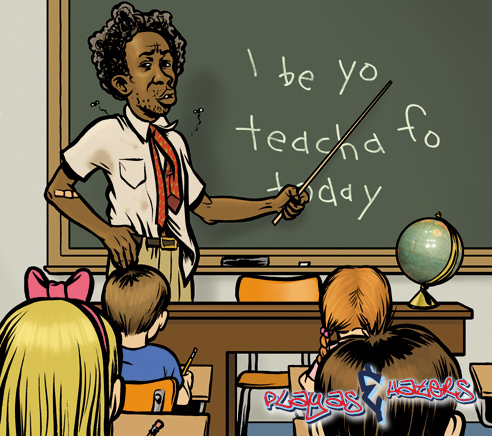
Example of Mock Ebonics: incorrect use of the invariant habitual “be”. Also note the use of eye dialect and lack of code-switching.
Mock Ebonics (1800s- ) is vernacular Black American English (Ebonics) produced by non-native speakers – from Internet trolls to Hollywood screenwriters to the old blackface performers of the minstrel shows.
In most cases it is verbal blackface, making blacks look like they lack intelligence, excusing the racism against them.
On this blog it is almost always the most racist whites who use it.
Warning signs:

Mock Ebonics – assumes that Ebonics is just bad grammar. “I has” is not just bad Standard English, it is bad Black English too. Only animals in Internet memes talk like that.
- Overuse of the word “be”. Ebonics uses “be” to show that an action is regularly repeated or a matter of habit. Mock Ebonics likes to use it in place of “is”, “am”, “are”, etc – as pictured above.
- The speaker is white: extremely few whites speak Black English natively or have a non-racist motive for using it.
- Use of racial slurs for whites: whitey, honky, cracka. Since the 1970s this has become almost a requirement.
- Overuse of slang and offensive words. Like motherfucker, shit, ho, bitch, nigga.
- Use of stereotypes: The speaker shows a narrow, stereotyped view of blacks.
- Lack of code-switching: Used where most blacks would not use Ebonics. Like in blog comments.
- Heavy use of eye dialect: dis, dat, fo’, yo’, mo’, given’, troof, axe, raciss. Even when it does not change it from how whites say it: wuz, skillz, n’.
To most whites Ebonics sounds like slang and bad grammar, so that is what Mock Ebonics becomes. But, as it turns out, Ebonics has a grammar, one that cannot be guessed by non-native speakers.
When whites try to write in Ebonics, like for a minstrel show or a Hollywood film, they mostly get it wrong. That means blacks who take those parts have to learn a white person’s idea of how to talk like a black person! Something Robert Townsend made fun of in “Hollywood Shuffle” (1987).

Mock Ebonics: “I’se” comes from the minstrel shows, not from Black English. Zora Neale Hurston called this “weird” – no black person talks like that.
Zora Neale Hurston, who heard the Mock Ebonics of minstrel shows, said it was “a weird thing, full of ‘ams’ and ‘Ises.'”.


Mock Ebonics gives Ebonics a bad name, which affects black writers. Some avoid Black English and pretty much stick to Standard English, like James Baldwin or “The Cosby Show”. Some use it anyway, like Langston Hughes or “The Color Purple”. Some use a Standard English informed by Black English, like Malcolm X (Chinua Achebe did the same in relation to Igbo).

Stepin Fetchit in 1930. He made over a million dollars speaking in Mock Ebonics in Hollywood films.
The trouble with using Ebonics in front of whites is that it sounds just like Mock Ebonics to them. Which only confirms everything they believe about blacks lacking intelligence, about how blacks are holding themselves back and only imagining that whites are racist – overlooking the fact that most blacks have no trouble speaking Standard English.
 And yet, strangely, whites use Mock Ebonics to make themselves sound cool. So tons of words and phrases have crossed over from Ebonics to Standard American English, like put-down, wing it, check it out, blow your mind, laid-back, dude – and the word cool itself.
See also:
- Ebonics
- Standard English
- minstrel show
- blackface
- stereotypes: black people according to white people
- Langston Hughes: The Negro Artist and the Racial Mountain
- Chinua Achebe: The Politics And Politicians Of Language in African Literature
- Ngugi wa Thiong’o: The Language of African Literature
- Zora Neale Hurston: What White Publishers Won’t Print
- Why do whites hate, demonize, fear and look down on blacks?
- Mock Spanish
- ching chong

 Abagond
Ha ha. Great post, as always, Abagond. Love the graphics, especially Atticus Finch being drenched with Colt 45. I only have one issue with what you wrote: you said, “On this blog it is almost always the most racist whites who use it.” Now, Aba, you know this is NOT true. It’s not *almost always,* it’s only ever always, unless a commenter is actually quoting or mocking the racist white commenter who originally used ME (Mock Ebonics).
LikeLike
Absolutly , Ebonics has crossed over into standard American English, and actualy has made it healthiar…The same thing happned in Brazil. I used to have cable in Brazil and got a channal directly from Portugual. Its much stiffer, Brazilian language peppered with slang coming right from the black streets , and it flows much looser .
Some words actualy have African roots from specific tribes that the people came from, like “funk ” and “samba” and I think even “booty” might , but Im not for sure
A lot of those words that crossed over are right out of the jazz age ( “jazz” it self is a slang for “sex it up” , sex also being a word with lots of slang words about it ) , “cool”, add things like “man” ( did the old jazzers use that to counter the racist use of “boy”?), “groovy”, “jam” ,”cat”,”dig”…These jazz musicians were intent on developing a lingo that white people couldnt follow , sometimes related to drug culture…it always puts it ahead and on top, and pushes the language to evolve…just as I stated on another thread, in religions like Candomble, Voodoo, Santaria, slaves were hiding their cultural dieties behind Catholic Saints. It makes me imagine that there were many things that slaves were comunicating to each other that the white man didnt know about…
As usual, the white man is part atracted to Ebonics and part repelled by it and mostly just mocks it in the worst kind of way and doesnt get it and never will ..that is why you see the blatent examples in this thread Abagond wrote
When I was younger, words like “short (car)”, “boss (really cool) “,”trim(getting some sex with a woman)” “gouster (working class black man as oposed to “ivy leaugue”)””boats(shoes)””threads clothes)” and others were used in the black comunities in Chicago
LikeLike
Most people in France do not know that what is spoken and called “Créole” in the French West Indies (Antilles) is actually a syncretic form of language that uses French and other lexicon, French and mostly African grammar.
I know a little of African patois and I could tell (also with my knowledge of learning and teaching languages) that there are obvious similarities between the patois and Créole.
Would you call Ebonics a creole language ? I have rarely read academic work about it, so I don’t know in its normative approach is that of a creole. I imagine it is.
Also, the accents of people speaking creole in the Carribean (French or English creoles) is so close to that of Africans speaking these patois, it is obvious the African influence is strong.
I started learning Guadeloupéen but didn’t have time to continue and even noticed similar words in the grammar basics like subjects, in particular “ou”, the same exists in Western Cameroon patois… The most surprising thing for me was to notice that the booklet that accompanied the CDs had nowhere, absolutely nowhere a reference to the African origin of creole !!! Even though the method was developed by two Afro-Caribbeans !
Some years ago, I attended a conference by Haitian author and thinker Jean Metellus and COULDN’T believe my ears when I heard some racist idiot in the audience ask him: “but what you speak is not a language, that “petit nègre” language of yours”. WOW ! The guy’s brains couldn’t even fathom the distance between his intellectual capacities and Metellus’s, but I guess this is what allows them to act and speak the way they do. Profound ignorance. Metellus crushed the guy to the ground with superb irony, but of course the idiot didn’t get one ounce of it.
“petit nègre” would be the French for mock Ebonics, it translates as “little nigger”, literally, only racists dare use the expression openly. It is also used to describe a confused speech or written piece.
Nice post !
LikeLike
The last para brings up the point that whites can always put on the accoutrements (real or imagined) of ‘others’ to appear ‘cool’ and exotic. They are able to do that while remaining white and safe. However, those very same things, when done by POC as part of their natural culture, are devalued and used against them. So if you’re black your natural skin color may be mocked. If you’re white, a tan gets you compliments. Mock ebonics in minstrel shows and the runaway sucess of musicians such as Elvis and Eminem all seem expected when you look at the pattern.
The other thing that rang true for me is the use of the slur “whitey”. It’s usually uttered by white people pretending to be racist black people. Just a heads up: if you want to pretend to be a “black racist” don’t post things like “kill whitey!”. That is a simple inversion of white racism against blacks (“kill n*****s”) which doesn’t exist in practice given the asymmetric nature of racism as it developed beginning centuries ago. The things that white people usually view as racist are black recollections of the injustices perpetrated against them. So if you want to be a “black racist” post those. But I bet you wont…lol
LikeLike
@ Bulanik
You know, my mom has a book that is a collection of her poetry that she babies to death, that book has been through a lot and it shows lol. I read it as a kid and as an adult, each time with new eyes. While the slang of my native island differs some (duppy = jumby, unu = aya, ku = ki etc), the stories come through as clear as day and I love them. Moving away made me appreciate Caribbean cultures more, I took note of all the things I took for granted, like someone who I consider to be the same as me there, would be placed in a whole other group here and the messages slowly work their way in (if you let them).
——————————–
As far as black American Ebonics, I get it (if I try to speak it, I’ll sound like an ass) but I get it . I also notice this level of contempt for it, almost like its some kind of attack on white American hegemony, most don’t realize that black influence is already there, its not some alien thing.
LikeLike
“Mock ebonics in minstrel shows and the runaway sucess of musicians such as Elvis and Eminem all seem expected when you look at the pattern”
Good point, Origin…what could be considered minstrel shows by entertainers out here? How does Mick Jagger stack up?
Rock music is a great place to find words that are mock ebonics
How about a British guy who gets on the mike and sais “Word to the brotherhood…” in a pretty crude , I can only describe as minstrelistic delivery…?
A whole whole lot of people in this word are inspired by black music , my opinion is if someone really goes the extra mile,practices the techniques and concepts with the masters ( I mean really practices it) , really tries to understand the depth and feeling and history behind the music they are interpreting , gives credit where credit is due , and puts in the discipline, all I can say is pull me into your story….if someone starts stereotyping, mocking, doing half stepping, not very respectful and shallow interperatations, wont give the credit in interveiws,its a turn off for me…
LikeLike
Eminem. (reflecting from Origin’s comment)
That is an interesting character. I don’t know enough about Elvis to compare them, but from what I have read, Elvis was kind of raised in a “black” environment musically speaking and took that with him when he swooshed through the “veil” back into the real -financially speaking- world…
Eminem, hmm. I have been a listener of hip hop for many many years and was in the US at the height of hip hop, lived through the Stop the Violent movement, went several concerts and to one of those Stop the Violence concerts that toured the US (I was in South Carolina at the time).
Back in France, I followed what was happening in hip hop (not very enchanted with the new trends) and one day I am driving, and I hear that song and I’m like: “Damn, who is that ? He is good ! “. I stopped on the side of the road to listen to the song whole song. Wow. I hadn’t heard something that “fresh” in a while. It was Eminem. I had no idea who he was, but I had an idea that he was a good rapper. That was all.
Then I searched to “see” who he was and “saw”. So, really, I don’t know. I don’t feel like Eminem “stole” much because he had enough talent to be where he was. Now, the rest is the control from the industry. And that served him. But when you hear a J-Zay talk about how Occupy WS is this and that… and how the “poor” 1% are being targeted, blah blah… As far as hip hop spirit, we are now very far…
LikeLike
The internet trolls who show up here and there are notorious for using Mock Ebonics. Don’t be surprised if one shows up here who will gladly and unwisely give us a demonstration.
LikeLike
Peanut , very good insight…good luck on your book..
I cant even lie, first of all, there was no definition “ebonics” when I grew up,and, Im a jazz musician ( among other Afro diasporic groove interpretations I am devoted to), phrases that are natural to even just moving equipment around , are slang or could be perceived as talking black…I might even write phrases that come out like that, because , its too deep in me at this point, its part of my profesion and its ingrained in jazz terminology…if someone perceives certain jazz phrases as “ebonics”.
So, my question about Elvis, why wasnt he around some black guys in his band in the early days ? He seems so off in his corner, not so inclusive…
Emenem ? The guys made too many raps putting down people and whining about his mother…Id lke to see a little more of a dance ethic coming from him .Getting voted “Artist of the Decade” by somewhere I can’t remember, is too much for me…I think white rappers have to get some dance steps on…they cant get over just running their mouths with white anxt
Abagond, I have to say, the swear thing , being from Chicago, was more our impresion of how New Yorkers acted…make no mistake, there are some very tough people in Chicago, but, New Yorkers in the 70’s, took the cake with swearing, it seemed they would do it just ordering some desert from a restaraunt
LikeLike
these are the kind of people I have to work for…
LikeLike
@ Peanut
I would count “The Help” as an example of Mock Ebonics. The most clear-cut thing is the use of eye dialect: When “Miss Skeeter” talks, all her words are correctly spelled. But when Aibileen speaks, “of” becomes “a” and “them” becomes “em” – as if white people never say those words that way. As if white people talk like the London law clerks of the 1400s whose accent English spelling is based on.
Three other warning signs apply to Stockett: she is white (not a native speaker), she stereotypes blacks and she puts racial slurs in their mouths (whitey, cracker).
LikeLike
@ Origin
Excellent observation. I agree completely. People who think there is a black counterpart to the n-word misunderstand why there even is an n-word to begin with.
LikeLike
Interesting. Good post.
But what happens when a black man speaks brilliant and flawless queen’s english?? The way that is portrayed, particulary in US media, makes it look pompous and stupid, as if a black man does not speak “naturally” with upper class accent nor has the education associated with that type of english. Case of point, the black butler in Fresh Prince back in 80’s.
Also, if you talk with any one with thick local accent in England, you’ll lear fast that even the english accents differ from each other in huge variation. Add to that mix the local slang spoken, say, in Newcastle or Manchester or in different parts of London, and you realize that the english you thoughed you knew does exist only in our minds, not in real lives.
I have always wondered the language spoken by the black actors in Hollywood movies, the old ones. Does anyone know when a first black actor spoke normal way in Hollywood movies?
LikeLike
Some Jamaican Patois words from African languages:
Akan: ackee, dupi, nana
Akan/Ewe: anansi
Akan/Igbo: se
Igbo: awoh, big-eye, obeah, okra, unu
Wolof: nyam
Fula: juk
Map of Niger-Congo languages:

LikeLike
[…] "Mock Ebonics (1800s- ) is vernacular Black American English (Ebonics) produced by non-native speakers – from Internet trolls to Hollywood screenwriters to the old blackface performers of the minstrel shows. In most cases it is verbal blackface, making blacks look like they lack intelligence, excusing the racism against them." […]
LikeLike
I remember the big noise made about “teaching ebonics.” back in ’97. My mother thought it was absolutely ludicrous. “Who they kiddin,” she’d say, “Just tryin get outta teachin them kids to talk right.” I don’t think she ever quite got why I’d snicker every time…
As for myself, I spent my school years as one of a very small number of white kids at the schools I went to in Mobile, AL. And of course, that’s how everyone talked, so I’d pick it up, and save the “Redneck” talk for when I got home. By the time I was about 15, I’d pretty much given up on “redneck” ’cause it made me sound like a damned idiot. I will never again utter the words “Yawl gunn cummon over er whut?” when inviting people to my home.
…And then we moved to Alaska, and DAMN, that was like moving to China or something, as far as language went.
LikeLike
So, the white wierdo thinks that he/she has the ‘black mind’ in a small compartment in the the back of their own, but all they are doing is revealing their ignorance and racism. Oh, and wheres duckduck? Haven’t heard from him in a while.
LikeLike
He’s banned, you missed it, sir! 🙂
LikeLike
Beat me to it -_-
LikeLike
^^ when, where, and how?
LikeLike
@ Satanforce
He was banned on August 1st for using a sock puppet:
He has vowed to return under a different name.
LikeLike
This is a fascinating topic and I would commend McWhorter’s “Word on the Street” to anybody interested in it.
It’s interesting how “mock ebonics” genrally ignore the actual grammar of actual BEV. You see the same with “mock southern”. There is a southern rock group, the Drive By Truckers, with a song that contains this line: “He knows that blood red carpet at the Salem Church of Christ ain’t gonna ever see no weddin’ between you and me.” A non-southern speaker would have written: “.ain’t never gonna see no weddin’.”
As to BEV affecting standanrd English, it of course does, and it’s natural that it would do so.
LikeLike
A shame really. The high levels of unemployment, combined with a culture that encourages the mentally ill to act out in publicly self-destructive ways. i hope that duckduck will get the help that he needs, as I feel that he could possibly be positive contributor on blogs like these.
LikeLike
When I was young, I really didnt like reading Twains “Huck Finn”…How he dealt with “Jim”, just felt wrong. The mock ebonics were not hooking up with my real experiances in my life with an integrated school and lots of interaction between all kinds of people. I read Burroghs Tarzan novels, of course I saw through them and the notion a white guy could rule the jungle and the people from there.It was one of the few ways you could try to have something about Africa, I even loved the scenes in the Weismuller films where he has to save the whites from getting split by the trees tied together…they always played some killer authentic feild drumming in those scenes and I just loved that…but hated the false depictions…I knew back then that it was wrong and prejudiced.
I also didnt like George Gershwins Porgey and Bess with its mock Ebonics….when the truth is starting to steam in, its easy to see through these portrayels and know they are false and wrong
LikeLike
“Chano Pozo lives in a thatched hut in Mongo’s mind….”
LikeLike
THE LOVESTRUCK LOCUST: When a culture, a nation, or the peoples of that nation benefit from another People or culture, or integrate the choicest superficial trappings of that culture at the same time it demonizes or exploits or visits violence upon that same culture, I call the dynamic The Lovestruck Locust.
http://www.theunapologeticmexican.org/glosario.html#lovestrucklocust
LikeLike
Awesome post/discussion. I remember when the ‘Ebonics’ debate was fresh;the mocking from black people and others was disturbing. I ALWAYS saw ebonics as the ‘dialect’ or the cultural adaptation of linguistic rules of a culture which did not learn American english through the ‘Rosetta Stone’ or ‘Berlitz’ language courses. Also, some elements of ‘ebonics’ has remnants of west African linguistic rules, in particular, ‘to be’.
In addition, when you factor in, the role of segregation, southern whites’ speech patterns and lack of access to education/sub-standard education, it makes perfect sense that black American speech patters were reflective of this experience/process.
LikeLike
“Gen,
Moving away made me appreciate Caribbean cultures more, I took note of all the things I took for granted, like someone who I consider to be the same as me there, would be placed in a whole other group here…”
Linda says,
That’s why I resent people trying to push everyone based on colour into one big group as if seperate ethnicity,culture, and heritage does not define us.
Every culture has that little “thing” that makes it unique that outsiders just don’t know about unless they were born and raised in it.
When I first moved to Florida and heard the local black Americans speaking to each other, I didn’t know what they were saying. I made a few friends and learned about their heritage and vice versa but even after that, I didn’t try to speak like them because I sounded silly
That’s why it can only be interpreted as an “insult” and “mocking” when white Americans use “ebonics” in speech and try to say they are being authentic at the same time. You have to be around native speakers for quite awhile to learn proper phrasing and syntax.
LikeLike
“Bulanik,
I am in 2 minds about the use of patois.
On the one hand, it has its pride of place — it must have it’s definition and recognition, but on the other hand, the users of the language cannot use it beyond a point. I suppose that’s what being bi-lingual means.”
Linda says,
It does have it’s limitations as a “language” but it certainly is colourful.
Here is a cartoon series I fell in love with…gives me a good laugh everytime and reminds me of home.
LikeLike
My very first day on my new job, I’m being introduced to people in the office. This white guy takes it upon himself to greet me with, “Hel-lur,” a la Madea.
I’m not sure which was sadder. My embarrassment and anger; his confusion when he realized I was not happy to be greeted in such a way; or the poor white girl showing me around who had no idea what he was referencing and had never heard of Madea or Tyler Perry. “What is he talking about? I don’t understand.”
Unfortunately, I understood all too well.
*sigh*
LikeLike
What the mock Ebonists dont realise is that “Ebonics” is actualy very witty, has a lot of humor and is pretty intelligent…they got it opisite, thinking its some butchering of English or something
LikeLike
My problem with “Ebonics” is that it assumes that all African Americans have the same vernacular. All you have to do is travel up and down the East Coast to see that this is untrue. I remember my first time in Philadelphia and how I noticed all these words and phrases that I’d never heard in my life, like “bul” (boy) or “I feel some typa way”. And even the grammar differs when one goes South (“I’m f”na go” or “he dun tole me”)…
Yes, I agree that these are all enough to constitute separate languages from English (just as Afrikaans is a separate language from Nederlands), but there’s no universal “Ebonics” amongst all African Americans.
LikeLike
Bulanik
Yeah I can see that, it’s not something that is generally applicable. My parents have a level of stubbornness about it though and they gave it to my brother and I, basically, don’t let arrogant people foster shame in you about where you come from, Caribbean tongues tell the Caribbean story. They also encouraged me to learn other languages and listen to different kinds of music.
@ Linda
Agreed! When I came to Florida it was the same thing! There were white kids who had Ebonics down perfectly because that’s just what they know, they were immersed in it. The people who can only mock a language don’t think and feel in said language, they not only miss the syntax but the crackle and subtle queues in inflection and even body language. Like I saw this older woman of East Asian descent the other day, sitting in her car on the phone, I can’t hear what she’s saying but I heard her laugh followed by a particular squeal of glee/disbelief that I’ve heard a million times before, and right away I thought, “Shes an island woman!”.
@ B.R.
I agree. The play on words and codes that were created to keep suspicious, cruel and violent people out of your business. White Americans have the privilege of guessing what Ebonics should sound like and to even completely disregard accuracy because if they get it wrong, their intelligence and general worth as human beings don’t come into question and all the complications that can follow.
LikeLike
Whaa? What got my comment snagged in moderation purgatory? lol
LikeLike
This doesnt have much “Ebonics” in it, but it has a lot of street smarts (especialy check it out at 3:00 with Felipe Luciano, then of the Last Poets, since then , a jornlalist on New York TV), and “Ebonics” or slang, is a lot about street smarts…this is the shapness of mind that Ebonics ” comes from
LikeLike
should read, “sharpness of mind”
Yeah, “The Last Poets”, ahead of their time
LikeLike
Lester Young is one of the greatest jazz saxaphone players of all time.
Just check out this page from a jazz forum talking about all the slang that Lester introduced, and, the jazz world is the fonte of a tremendous amount of slang in American vernacular:
http://forums.allaboutjazz.com/showthread.php?t=15886
LikeLike
http://www.jazzquotations.com/2010/05/list-of-jazz-slang-words.html
Just look at all these words that came from the jazz world…many are in use today….they said Lester was the one who coined the slang “cool”
LikeLike
Off the top of my head, the novels that I’ve read that did use Ebonics the right way were: Perfect Peace by Daniel Black, The Color Purple by Alice Walker, The Darkest Child by Dolores Phillips (no coincidence that they are all AA authors.
LikeLike
It absolutly blows my mind how many words are on the “jazz slang words” link. That is a tremendous list, extremly creative,descriptive, witty, sharp , extremly hip…most of , from black American jazz musicians….think about this for a second, this large , familiar, expressive list , is the definite base of most of the slang that evolved after that, in rock and roll, funk, disco, and hip hop..yes , new words, but , evolving out of a base that surly has roots in this large list of words that these jazz musicians comunicated to each other with.
So, let me get this straight, these jazz shamons, black American musicians, are deeply involved in practicing the profound fundimentals of the genius of Afro Diasporic culture , deep in improvisation , over pollyrhythmic , call responce melodies, harmonies filtered through the blues , putting themselves in high leval alpha states, getting in touch with intuition, and feeling……are also fundimentaly changing the language of the American culture , in the most creative and profound way ? That profoundly affects language right down into today…mostly tied into …musical culture ( which doesnt say other things arnt pushing the language also, like surf life and computor life, but check out those jazz words…a huge amount that are right into today and contemporary and others that are accepted in formal circles like “cool”…).
These arnt the only black American expresions, but, by gosh the jazz list is the largest contributor to black slang than you can find…black American writers didnt contribute as much to black American slang…and look, a guy like Lester Young coined quite a few words and expresions himself. Add pockets of his contemporaries and all the words they passed around, traveling a lot…a whole lot….and you can pretty much ascess that its a relativly small group of people ( several thousands?), who are very cool and very hip who are setting trends in how to walk, talk , dress, , and play music , and create dance styles….who have an enormous influence on how black Americans evolved their culture and then white people picked up on it , then the whole world..and how it affects down into today…
LikeLike
The Apple — New York city. This is now common usage.
We got a gig up in “The Apple” at Minton’s with Diz and Bird.
Axe — An instrument.
Hey, Jack, bring your “axe” over tomorrow and we’ll jam.
Baby — A term of endearment.
Hey, “baby,” I got some bread, lets paint the town.
Bad — Good.
Thar dude Wynton Marsalis does some “bad” ass playin’.
Bag — A person’s particular interest.
I’d like to play with your combo, dude, but your sound just ain’t my “bag
Beat — Exhausted or tired.
Man
The Bomb — Very cool.
The Crusader’s new CD, “Louisiana Hot Sauce” is “the bomb
Bread — A jazzman’s word for money.
Alright, Jack, if ya want me to play, ya gotta come up with some “bread.”
Break it down — Get hot!! Go to town.
Bring Down or Bringdown — As a verb – to depress. As a noun – one who depresses.
Hey, man, don’t “bring me down” with all of this crazy talk.
Hey, let’s get out of here, that guy is a real “bringdown.”
Bug — To annoy or bewilder.
Man, don’t “bug” me with that jive about cleanin’ up my act.
Burnin — Used to describe a particularly emotional or technically excellent solo.
Hey
Cans — Headphones.
That last take was really kickin’, put on the “cans” and lets record the final take.
Cats — Folks who play jazz music.
I used to partake in late-night jam sessions with the “cats” over at Sid’s.
Changes — Chord progression.
Hey, Pops, dig those “changes” that the Hawk is playin’.
Character — An interesting, out of the ordinary person.
Sonny is certainly a “character.”
Chick — A young and pretty girl.
LikeLike
Chops — The ability to play an instrument, a highly refined technique. Also refers to a brass players facial muscles.
“He played the hell out of that Gershwin; he’s sure got chops.” and “My chops are still achin’ from last nights gig.”
Clams — Mistakes while playing music.
Charlie is really layin’ down some “clams” tonight.
CCorny, Cornball — A jazz man’s term for trite, sweet or stale.
Man, Guy Lombardo is one “corny” cat. Man, Guy Lombardo plays some “cornball” music.
Crazy — Another jazz superlative.
Count Basie’s band sure lays down a “crazy” beat.
Crib — Same as pad.
Hey, baby, come on up to my crib awhile and relax.
Crumb — Someone for whom it is impossible to show respect.
Sleazy Eddie is a real “crumb.”
Cut — To leave or depart. Also to completely outdo another person or group in a battle of the bands.
Hey
linker — A bad note or one that is fluffed.
Hey, Charlie, that was some “clinker” that you just hit.
Combo — Combination of musicians that varies in size from 3 to 10.
Here me talkin’ to ya Lester. Did you see that supreme “combo” that the Hawk put together?
Cool — A restrained approach to music. A superlative which has gained wide acceptance outside of jazz.
Dad, Daddy-o — A hipster’s way of addressing another guy.
Hey, “daddy-o”, what’s cookin’.
Dark — Angry or upset (used in the Midwest).
Joe was in a real “dark” mood after Jaco showed up 30 minutes late for the gig.
Dig — To know or understand completely.
Hey, dad, I been listenin’ to what you been doin’ and I “dig” that crazy music
LikeLike
Get Down — To play or dance superlatively with abandon.
Jaco can really “get down” on the 4-string.
Gig — A paying job.
I’m playing a gig in the city tonight.
Gone — Yet another Jazz superlative.
Lester is a real “gone” cat.
Goof — Fail to carry out a responsibility or wander in attention.
Hey, Leroy, stop “goofin'” when I’m talkin’ to ya.
Flip your lid — Same as “Blow your top.”
That cat looks crazy. I think he’s gonna “flip his lid.”
Fly — Smooth or slick.
Hey, Eddie, did you see the hat-check girl Bernice? Man, she is “fly.”.
Fracture — To inspire or move someone.
You are the funniest guy I know. When you start to tell a joke, it “fractures” me.
Freak Lip — A pair of kissers that wear like leather; one who can hit high C’s all night and play a concert the next day.
Ol’ Satchmo, …now he had a pair of “freak lips!”
Funky — Earthy or down-to-earth.
That George Clinton is one “funky” cat.
Gas — As a noun – something that moves you. As a verb – to stir up feelings
Got your glasses on — you are ritzy or snooty, you fail to recognize your friends, you are up-stage.
Groovy — Used in the fifties to denote music that swings or is funky. For
LikeLike
Hip — A term used to describe someone who knows or understands. Originally “hep” until the 40’s or 50’s.
Yardbird Parker is really “hip”.
Hipster — A follower of the various genres of bop jazz in the 50’s. ThesIn the Mix — Put it together, make it happen.
Put that cat “in the mix,” we need a drummer for our upcoming tour.
In the Pocket — Refers to the rhythm section being really together as in…
Those guys are really in the pocket, tonight.
Jack — Jazz man’s term for another person. Often used in a negative manner.
Please don’t dominate the rap, “Jack.” Hit the road, “Jack.”
Jake — Okay.
Even though nobody seems to like him, that guy is “jake” with me.
Jam — To improvise.
The
e were the precursors of hippies in the 60’s.
Those “hipsters” that hang out at Shelly’s Manne-Hole are really diggin’ the West Coast sound.
Horn — Any instrument (not necessarily a brass or reed instrument).
That dude can sure blow his “horn.”.
Hot — A term once used to describe “real” jazz. Replaced as a superlative by “cool” in the late 40’s or early 50’s.
Satchel
LikeLike
Jive — A versatile word which can be used as a noun, verb or adjective. Noun – an odd form of speech. Verb – to fool someone. Adjective – phoney or fake.
Old Satchmo can lay down some crazy “jive.” Don’t “jive”me man, I wasn’t born yesterday. That cat is one “jive” dude.
JAMF – Jive A– Mother F—-R. Someone who is not thought highly of.
Joe Below — A musician who plays under-scale.
How can you expect to make a buck when “Joe Below” almost plays for free?
Lame — Something that doesn’t quite cut it.
Some of the cats that claim to be playin’ Jazz these days are layin’ down some “lame” music.
Licks, hot licks — An early term for phrase or solo.
Louie can really lay down some “hot licks.”
Licorice Stick — Clarinet
Gee, Jody, doesn’t it “chill ‘ya” the way Benny plays that “licorice stick”?
Lid — Hat.
Hey man, nice lid.
“Lid” has also entered the world of hip-hop slang via a company called Ultimate Lids that makes hats.
Moldy Fig — During the Bop era, fans and players of the new music used this term to discribe fans and players of the earlier New Orleans Jazz.
What do you expect, Eddie is a “moldy fig” and he’ll never dig the new sounds
Jump — To swing.
Let’s check out that bar over there. It sounds like the joint is “jumpin’.”
Junk — Heroin.
“Junk” and booze have laid a heavy toll on Jazz.
Kill — To fracture or delight.
You
LikeLike
Noodlin’ — To just play notes that have no particular meaning to a tune or solo.
Quit “noodlin” cat, let’s start working the tune.
Out of this world — A superlative which is no longer in common use.
I’m tellin’ ya, man, the way Benny Goodman blows is “out of this world.”
Out to Lunch — Same as lame.
That guy is “out to lunch,” I can’t stand the way he plays.
Pad — House, home, apartment or bed.
Hey, Lester, c’mon up to my “pad” you look like you need to cool down.
Popsicle Stick — A sax player’s reed.
I’m playing a great popsicle stick.
Scat — Improvise lyrics as nonsense syllables. Said to have originated on the “Hot Five” song “Heebie Jeebies” when Louis Armstrong dropped his lyrics.
I can really dig Dizzy’s new way of singing “scat.”
Scene — A place or atmosphere.
In the late twenties, Armstrong was the man on the New York “scene
LikeLike
Scratch — (see Bread)
I need to get my axe fixed, but I got no “scratch.”
Screwin’ the Pooch — Really bad mistakes while playing music.
Roscoe must’ve had a bad day, cause he’s really “screwin’ the pooch.”
Send — to move or to stimulate.
Roscoe, you really “send” me.
SSmokin’ — Playing your ass off.
I can already tell from outside that Jimmy is “smokin'” tonight.
Snap your cap — Same as “Blow your top.”
Hey, Buddy, calm down. Don’t “snap your cap.”
Solid — A swing-era superlative which is little used today.
Little Jazz can blow up a storm, he’s really “solid.”
Split — To leave.
Sorry I can’t stick around Slick, I gotta “split.”
Square — A somewhat outmoded term meaning unknowing which can be a noun or a verb.
That cat is
harp — Fashionable.
Hey, Rufus, that’s one “sharp” looking suit of clothes you’re sportin’ there.
Sides — Records.
We sat around and dug “sides.” Or, as George Crater (or was it Ira Gitler?) once put it, “I sat around with another musician and Doug Sides.” ~ Bob Blumenthal
Skins
LikeLike
Swing — to get a rocking or swaying beat.
Ellington’s band “swings” like no other. It’s elegant.
Sraw Boss — From Dan Nicora: The term was explained to me by Richard Davis, bass player with Thad & Mel, and many NY groups. It refers to the lead alto player in a big band, being the dude who leads all the other saxophones, knows all of the answers and takes care of the crew.
TTrain Wreck — Event during the playing of a tune when the musicians “disagree” on where they are in the form (i.e. someone gets lost), so the chord changes and the melody may get confused for several bars, but depending on the abilities of the musicians (it happens to the best of them), there are usually no fatalities and the journey continues.
Tubs — Set of drums.
Jo is really hot tonight. Listen to him pound those “tubs.”.
Two beat — Four-four time with a steady two beat ground beat on the bass drum. New Orleans Jazz.
I can’t dig this “two beat” jazz. My boys got to have four even beats to the measure.
Wail — To play a tune extremely well.
Count Basie did a tune called “Prince of Wails” — a clever play on words. Damn, Basie’s
ag — Used to end the tune, repeating the last phrase three times.
Take five — A way of telling someone to take a five minute break or to take a five minute break.
Hey, Cleanhead, this is a cool tune and we’re blowin’ too hot. We oughta “take five.”
Too much — Just one more jazz superlative. Originally something so good, that it is hard to take.
Art Blakey is
LikeLike
Its so much more than origins of words or pronunciation, its how a whole way to speak and create new definitions is formed and developed with in a group of black American jazz musicians
Just look at the overwelming body of words here with such creative discriptive total changes of words to take on new charactor to fit in with the life style of these black musicians
I mean really,look at all those words…look how many are still in contemporary usage anyone can pick out a few words and find an origin, but this is a whole diolougue..a very hip diolougue, brought to you by black American jazz musicians
LikeLike
The huge body of words here is overwelming evidance that “ebonics” is firmly rooted in the black American jazz musician’s slang and diolougue…As a matter of fact, “ebonics” looks like a college university activist word and doesnt do the real deal justice at all…
Mock ebonics is more the misinterpretain and in most cases a put down on pronunciations that are actualy more southern diolougue straight from how the southern white man can talk , for sure not all southern white men, but that is where those inflections really came from
LikeLike
“misinterpretation”….an “infelctions” meaning the inflections you will find in mock ebonics, whish is racist misinterpretation..even when meant to be with good intentions like “Porgy and Bess” , from Gershwin….its like its white men defining to themselves what they thing black people talk like
LikeLike
gees, my normal dreadful spelling is worse today
“inflections”
“what they think black people talk like”
“which is racist misinterpretaion”
LikeLike
http://www.hiphopgalaxy.com/rap-dictionary-hip-hop-2099.html
How about the hip hop dictionary ? Some of those words came from the jazz words…it is an extention and , it is notably tied into , among other things, the cultural movement with the music….
LikeLike
http://wiki.answers.com/Q/How_has_India_influenced_American_Culture
LikeLike
http://www.newgeography.com/content/002098-what-india-hands-world
LikeLike
Id give my left xxx for a good Indian restaurant where I live
LikeLike
I’m not sure they would know how to prepare your testicle.
LikeLike
Hmmm… I going to agree with Bulanik. I’ve heard too that punani is an indian word. I does sound indian to my ear.
And pumpum! What a great word. So delightfully descriptive.
Fatty bum bum: http://www.youtube.com/watch?v=vANcgolYNds
LikeLike
Humble Finland’s contribution to all things pum-pum or pump-pump.
Brace yourselves, folks. Meine damen und herren:
LikeLike
It seems that the “I can haz cheezburger” meme/movement is a new and improved version of mock ebonics. I enjoy a good meme every now and then, but I never found the humor in that particular one. Something about it always felt exploitative — maybe this is why.
LikeLike
All of the 7 points I have noticed without ever stepping out of my country(thanks, but no thanks, Hollywood!), also there are internet photos of animals speaking Ebonics. >_<
LikeLike
White trolls who write on Internet message board aren’t fooling anyone. Usually, they write in troll-Ebonics to try to mock black posters or try to change the direction of the dialogue.
I remember the Globe and Mail newspaper (Canada) using mock Ebonics in an editorial cartoon in 2007. They did it to mock some black folks who wanted to start an Afrocentric school. They pictured a black teacher trying to teach math and struggling. Here it is:
LikeLike
I just saw this today: http://youtu.be/LSbAiy35MTk
It’s a 14-second clip of Stewie’s reaction to getting rejected from American Idol.
Lots of I’se and They’se to be heard.
LikeLike
@ SW6
The New York Times had an article about Obama’s use of “Negro dialect”, as Senator Harry Reid called it:
They drew this comparison:
Obama telling a black cashier to keep the change:
Romney attempting to interact with black children at a parade:
The latter I saw in a video about how Romney is a robot! He is a real creepy dude.
As to Malcolm X, he uses Standard English grammar and, for the most part, Standard words, but he still comes off sounding like he is black somehow. I wish I could put my finger on it.
Things I would like to see tried:
1. A talented white public speaker or actor giving a Malcolm X speech.
2. Use a script from “The Cosby Show” with an all-white cast. (I think John McWhorter said that no one would notice the difference.)
LikeLike
Malcolm X was from Detroit, there were black comunities growing in the big northern cities way before the southern migration. Too many times, mock ebonics is really mimicking a southern dialect.
I think Malcolm X has some aspects of his delivery like Obama…
I agree about Gershwins Porgy and Bess mock ebonics…
LikeLike
Too many people dont want to acknowlede, a huge part of black slang does have its origins in black American jazz musicians comunicating with each other. It all gets lost in the shuffle. I think slang is very healthy to a language keeping creative and evolving. But whether its white people deteriating into mock ebonics because they just dont get it , or activist university meetings that coin the word “ebonics “, they arnt going to embrace and celibrate the fonte of the real source and reason that black American slang is so creative, powerful and meaningful to the evolution of American English.
This creativity is linked to the culture of music , it kept going into rhythm and blues, rock, hip hop, but, lets face it, the majority of slang words, accepted in the mainstream and the ultra hip slang, have their roots in these black American jazz men and women.They are the shamons, they were directly in touch with the gift and genius that came from the ancient African concepts.Is it any wonder that they could , with their genius and creativity .
The same thing happens in Brazil, I cant understand some of the really heavy players because they speak with so much slang (gira)…its the same process, its cultural , and linked with music (obviously there are other fontes of slang, like the drug trade, surfing, computor world, but nothing as huge as the slang that came from black American jazz musicians or the black streets of Rio and their cultural musical developement)
Ill give you an example of this creativity. We jazz musicians use the term “gig” for a job, I have a black American colleague, who is a genius, seriously, who just never got his break. We were talking about a bad “gig”, that paid little and was chumpy, he said, “that isnt a gig, that is a “gag”( an old time comedian word for a joke,probably meaning gag on laughter)”…I mean, we cracked up and laughed tremendously, its funny and witty. It didnt make it into any lexicon of national slang use, but, for those of us there, we use it now to refer to chumpy gigs that are a joke
LikeLike
“is there any wonder that they could, with their creative genius and creativity , totaly transform the national way of speaking and comunicating?”
is what I meant to say
LikeLike
In my many years of living I’ve never once heard 1. obvious Ebonics, and 2) obvious racist remarks from any Black people I have come across. A few times I’ve heard some weird comments and behaviors about White people (very interesting, but not relevent to this post) , but nothing like “cracker” or anything hurtful like that.
Also, I was watching Hoarders yesterday, and there were some real country people on the show, but all I heard were some distinctive Southern Black accents (and I was listening, because I had just read this post and was curious). No poor English, no minstrel talk. I’ve never understood people thinking that everyone talks like Mammy. I’ve certainly never heard it outside of comedy or satire.
LikeLike
“As to Malcolm X, he uses Standard English grammar and, for the most part, Standard words, but he still comes off sounding like he is black somehow. I wish I could put my finger on it.
Things I would like to see tried:
1. A talented white public speaker or actor giving a Malcolm X speech.”
****************************
My thoughts:
Malcolm possessed copious amounts of charisma, tone, sharp wit & intellect, sense of urgency, street cred, confidence, truth, selflessness, swagger and unwavering character all wrapped up in his voice, tone, inflections, gaze, body language and dignified personality!
Of course he would sound black. One reason being is that only a radical black person could say things that greatly provoked/offended white people.
It’s perhaps as if the Creator specifically created/designed Malcolm X for a special assignment. Denzel gave us a fair depiction.
I’m not aware of any white person, actor or otherwise talented who could do justice to Malcolm.
LikeLike
This site might be one representation of a collection of common “Black language” in print. Think of all the Black people who have commented on Abagond over the years that this blog has been in existence. Yet, how little ebonics has ever been used.
LikeLike
I think that is a very acurate description of Malcolm, Matari
I think there has been use of the slang, that came from the list of slang from the jazz world, because a lot of those words are now engrained in everyday American converstion ” wow, that was a cool movie I saw, it really blew my mind” , ” Im feeling dark today, things have been bringing me down”…you really cant get away from it if you just talk everyday American conversation
Ironicly, Pentagon , you used the term “country”, which is a black expresion , that black Americans who lived in the northern big cities , would start calling the southern black Americans who came up in the great migration north
Yes, many southern black people actualy have good diction.
Its the mock ebonics that bring in a really distorted pronounciation, which is how white people demonstrate to each other, their warped idea of how black people talk
I use black American jazz slang in my everyday conversation with musicians about our profesion, and, the truth is, my black American mentors , that accepted me , and, had the confidence in me to be with them, make it an unspoken obligation to use the jazz words to comunicate with them (meaning the basic terms of the music, the instruments and the profesional paramaters of the working situation etc not some mocking imitation of being black).
By the way, you wont get any information about this in a jazz university. They may go back and study the greats, but, they are filtering them through European institutionalised point of view, they will never be able to teach it right, or be able to talk about the things that are really about the origins and roots of the music and the great musicians who played it. Many white jazz musicians will tell you that “jazz is for everyone and can be played by all people (which is true, meaning, if a white person really pays his dues and puts in the real time to learn to play, and they go to the masters to prove themselves,, they can come a long way into the music )” but, they may never understand the real roots, and the real contribution black Americans have made to changing American culture.
LikeLike
“By the way, you wont get any information about this in a jazz university. They may go back and study the greats, but, they are filtering them through European institutionalised point of view, they will never be able to teach it right, or be able to talk about the things that are really about the origins and roots of the music and the great musicians who played it. ”
******
I wonder, B.R., if teaching Music Appreciation or Introduction to African Jazz or some music related course work might be YOUR calling?? I mean aside from the contributions you bring to the table here.
You see beyond the veil of the “white gaze” and the typical “white framing” in at least a few areas of the African/black experience, especially as it relates to your appreciation and awareness that relates to beats, rhythms, words – not to mention your knowledge of musical pioneers and geniuses.
LikeLike
Interesting thought, Matari, I certainly am trying to pass these concepts on to younger musicians who I play on the bandstand with (I go into jazz forums debating these issues also, so, its not just something I say here), for them to “unlearn” some of the things they get in the universities that arnt plugged into these deep black American Afro diasporic roots. Because the bandstand is exactly where if they dont aproach the music from that deep ancient African knowledge, it becomes something else. It gets watered down , engulfed in arrangements, kicks, reading off paper (for sure doing a jingle or movie score, sheet music is very desirable, but, improvising and comunicating non verbaly, it can take away from the essence, the masters knew this, and they could read and write music very well) and it just isnt the same vehicle to unlock intuition and turn off the thinking brain and put oneself into an alpha state.
The bottom line is, Im not the fonte of this knowledge, Im just passing down what was passed down to me, and, I am in humble aweness at the truth and am very lucky to have been raised in an integrated neighborhood .
The last thing I want to sound like is I know so much and everyone should know what I know. Im just passing on truth that I was lucky to learn by being insprired, admiring, learning from and following the example of incredible black American talents that I was lucky to be around….not just in music, also, in everyday life. Maybe that is what seperates me from the university white jazz musician student. My everyday life has been integrated since I was young, and, I learned so much from just being open minded and not letting society tell me how Im suposed to think and feel about black Americans (which of course has translated into Brazil and other Afro Diasporic cultures).
Also, if the oportunity to teach officialy offerer itself , I would jump on it, but, it hasnt presented itself. I left music school when I found out I was learning more from black Ameridan jazz musicians , goiing with them to South and West side Chicago jazz clubs
LikeLike
SW6, that is the thing, these words and expresions are so integrated in everyday English comunication, we dont even know when we are using it
I think it should be embraced and celibrated for where it came from
LikeLike
Matari, Im glad you qualified saying “some aspects” because I would never try to say I know what it is like to be black in America. Or that I know everything there is to know about the black experiance. That would be the hight of pretension on my part.
Im not really a highly educated person, and, am not an expert on much in this world, but, the few things I do know, are based on personal experiance and have been hard earned life knowledge. In that spirit, I come in here, to listen , learn and share what I do know and have lived
LikeLike
All new languages probably started off as “slang” and gradually became more formalized with their own rules until they evolved into a new language altogether. How did we get French, Portuguese, Spanish and Italian from Latin?
I think what Ebonics shows is that whites and blacks in America to an extent live in cultural isolation from one another. From this cultural isolation will be born new modes of speech which if allowed to go on for long enough will become separate languages. Ebonics is just another variety of English, like Irish English, Scottish English, Welsh English, Jamaican English.
While I think black Americans need to master standard English to deal with mainstream society, there’s nothing inherently wrong with Ebonics and using it amongst your circle. It doesn’t deserve the ridicule it gets.
LikeLike
Ugh… When a white person is on the internet ‘trolling’ as a black person it is so transparent its painful. Something is always amiss.
LikeLike
LOL. I think “country” is pretty universal.
LikeLike
@Bulanik
Thanks 🙂
LikeLike
I heard “country” back in the 60″s, I dont think it was used in that mannor back then in other places…and not in the mannor Pentagon was reffering to.
This became a real black American expresion that was already happening in the black American communities in the early 60’s , refferring to people coming up from the south and coming into black communities that had already been established…it doesnt mean “you are from the country…the rural…the country side…”, it means customs and habits and ways of speaking , related to the southern United States, that were differant from the black communities that already existed there, and had rich cultural histories, like Harlem, the Southside of Chicago, the Westside of Chicago.And sometimes these habits and customs would grate up on one another and sometimes it would blend. Like , rural blues would come up and be turned into urban blues and electric instruments were added for new styles of blues.When it would grate, the original residents would start using terms like ” that person is country”
Its understandable that people who havent lived in the United States couldnt understand how this played out in an “Ebonic” concept in the black American community
LikeLike
What about using the word ‘ass’ for emphasis or as a qualifier? Examples: “ugly ass shoes” means very ugly shoes; ‘a big ass biscuit’ means a biscuit that is much bigger than is usual; ‘a grown ass man’ is an adult man who is not close in age to being a child / minor
From my own experience, using the word ‘ass’ in this way is common among Black Americans: I’ve used it, others around have used it, I’ve heard it used on Black TV shows and movies, OJ Simpson, as a matter of fact, used the phrase ‘ugly ass’ to describe the Bruno Magli shoes he denied owning, and, as I recall, the white media had a field day due to his use of the expression.
The use of ‘ass’ in this way seems somewhat uncommon among non-Black Americans….
LikeLike
“The use of ‘ass’ in this way seems somewhat uncommon among non-Black Americans….”
*****
Blu
“Smart ass” and “dumb ass” are common terms now used by non blacks. Aside from those, I think you’re dead on the money – as usual.
LikeLike
I love it when there is a new phrase that has some wit .
There was a term for police that was used , “5 O” , which is a spin off from the old TV show “Hawai 5 O” like ” be careful , 5 O just walked in the club”
Slang words that can affect the course of the national language , can come from a lot of differant places, prison slang, sex slang ,drug culture , life styles like surf , computor language , differant cultures contributing words that come into a national use , and that means any country , for sure it works that way in Brazil too .
Even more reason to be blown away by the amount of words in the USA normal use that came from black American jazz musicians
“I was blown away by that scene last night, it was so cool , the music was wild , except the first DJ was a charactor , he played some corny stuff that was crazy….” could be any young group of young women talking about a night out…its pretty standard stuff
“after I get some bread, lets go to my fly crib and check out this bomb dope…” could be a contemporary street wise statement , right now…
All from the jazz words
LikeLike
Matari,
Yes that is true.
I just never or only rarely have heard whites and others attaching ‘ass’ as an emphasisis for any word that does not concern someone acting a wiseguy or behaving stupidly. So, while white do use ‘smart ass’ and ‘dumb ass’ to mostly refer to people, I have never heard one say “That is one ugly ass hat she’s got on her head,” or “‘I’m a grown ass man you’re talking to like that. Watch your mouth!”… or words to that effect.
Then again, maybe the usage I’m thinking of isn’t as widespread as I’d assumed.
LikeLike
Does mash = mash up?
Bulanik
What comes to mind is Mash Potatoes – or the *Monster Mash* … a very corny song that charted in America during the 70s(?) which is totally different than the Island talk: “Ay Mon. Me gon ta mash imm face up good.” lol
LikeLike
@ Fiamma
“So, while white do use ‘smart ass’ and ‘dumb ass’ to mostly refer to people, I have never heard one say “That is one ugly ass hat she’s got on her head,” or “‘I’m a grown ass man you’re talking to like that. Watch your mouth!”… or words to that effect.”
Depends on where you are, here in Toronto most whites tend to use it in the latter example. I’ve seen people say “Why are you wearing such an ugly ass shirt/shoes/etc”. *shrugs* but then again we do have a pretty significant Jamaican population so most kids here might be influenced somewhat.
Could be a generational thing, I’m not sure. Most people I know above the age of 25+ do not use “ass” in that way.
LikeLike
I beleive Matari is reffering to the dance “the Mashed Potato”, here is Dee Dee Sharp doing a hit about it :
LikeLike
Interesting, this blog goes into huge detail about black Americans, people make large amounts of comments about black Americans , and lots of people like black American hits that they have heard, lots of people know about black American authors, and people know a lot about the black American civil rights movement, but, there isnt much knowledge about black American culture , about what it is, and what its origins are
LikeLike
“Depends on where you are, here in Toronto most whites tend to use it in the latter example”
– – –
Interesting, and surprising about the whites in Toronto using “ass” in that way, Yawn. It is not a Jamaican expression here in the States, as I grew up hearing it only among American Blacks, and have never heard it from any Jamaican or Caribbean person I’ve ever met (my Jamaican ex, as a matter of fact, considered it “odd”), and the only occasion where I recall hearing it from a white person, it was from the mouth of a young white guy who was probably raised around Blacks.
I’m thinking this particular usage may have been picked up by others from Black American hip hop, movies (Chris Rock’s “CB4” is an example) and TV shows (I’ve heard it used on the show “Martin”).
LikeLike
Bulanik,
Those two skits are pretty funny, especially the 1st of the two!
Thanks for introducing me to a previously unknown talent.
B.R.
Dee Dee Sharp’s – It’s Mashed Potato Time – is going way, way back to the 60s!!
The go-go girls with the hi-energy plus the splivvy foot moves, and Dee Dee’s permed/antiquated hair-do (no offense to Miss Sharp’s stylist!).
I’m happy to see that she has a web site and is still active..
LikeLike
To be able to address “mock ebonics” , there has to be an understanding exactly what “ebonics” is ( I feel the word “ebonics” is not a great one).
To underestimate that it is just some words, or some pronunciations, and these words are from somewhere else or also used in other places , is to diminish the value and power that black American slang really represents to American culture . It diminishes the power and creativity that black Americans have exerted on the USA.
More than just words and pronunciations, we are talking about a diolougue, a diolougue tied to , but absolutly not exclusivly, to culture , especialy music and dance culture of black America. That means in the early 1900’s until 1960 or so, it was brought to you in a big way by black American jazz musicians.Not only did they set cultural trends in music and dance styles, they were also doing huge amounts of traveling. They bore the brunt of Jim Crow laws that forced them to sleep on buses instead of hotels, or if they couldnt find black families to stay with. They had to go around the back to get food at restaurants if they could get food at all. And, they evolved a very special diolougue among themselves ,comunicating about their life styles, music and ways to not be understood by white people in genereal. And they contributed a huge amount of expresions and words to the national lexicon of expresion…an unbeleivable amount , so much so , that , most people dont even realise when they are using some of these expresions or words now.
And, it really begs the question that if there are that many expresions and words that were created out of the jazz world by black American jazz musicians, what was the same thing happening in the centuries before , starting when the first slaves were brought over ? How did black slaves comunicate to each other and what were the ways they hid what they were saying , thinking and doing to express their culture from the white man? America tried to destroy the culture of the slaves coming from Africa, and didnt want them to learn to read and write. We already know certain spirituals were coded messages for the Underground Railroad . So much has been lost , but, one thing is for sure, just based on what we know about jazz words, there must be a huge legacy of how black Americans comunicated with each other and hid it from the white man. BlackAmerican slaves were not sponge bobs, just neutral and not reacting. They were resisting in a big way. And, one of those ways was to speak to the white man in a way as to not provoke harsh reactions , to give the impresion they dont anything, when it really was just a defence , at the same time , having a coded way to communicate to each other.
Black American slang has revitalised American ways of speaking to each other. It is creative, witty, evolved out of struggle, and enormous. White Americans , not having any idea of what was really happening, mock the way they think black Americans are speaking, to each other. White Americans ought to be educated about how valuable black slang contributions to American culture, comunication and conversation is, and , its history and origins.And people outside the USa , should know they are really only getting corporate media interpretations of black American slang, from movies , TV , internet , with no real indication of the truth, the history and evolution , and, the media is only putting it in a box of something like “talking black”. People outside should know that it is really a very hip diolougue tied to a very powerful culture with an important history
LikeLike
Matari, your post came in as Im typing….
Yeah, I go back to the 60’s,that is how I know about “the mashed potatos” and that “country ” was used by black Americans from the northern cities as a way to describe how they felt about the huge amount of people arriving from the south. I mean “country”, the word, is used in a lot of ways in the states, like “country western”, but, how black Americans used it , was in a specific context , that is unique to itself…
LikeLike
One thing some black Americans on here might recognise is, regional differances in expresions and words in black American communities throughout the USA. “Black slang” and “black Americans ” are not monolithic and one solid block…it is many regions, areas, many differant individuals , differant opinions , outlooks…
It even plays out in music and dance , there is a New Orleans sound, the “Oakland stroke “, “Philly sound”, “Memphis sound”, the “Miami sound (with a Cuban influence)”, Chicago blues , jazz and house music, New York be bop, hip hop and a huge Puerto Rican influence etc..
In Chicago, there was a word and expresion for the wind that was so cold and could cut you like a razor walking down the street, it was called “the Hawk”, which is a pretty witty to have that word…Lou Rawls brought national attention in a hit he had…and he talked about “the Hawk ” in that song ( I think it was a song about Chicago).
LikeLike
I really enjoyed these, especially the rhythm and the rolling of the lyrics. And Eyrykah’s use of the signs with words was innovative and inspirational.
Good stuff, right stuff.
LikeLike
When I was in my teens, in the black comunity, there was a term for how to do a cool walk coined “pimp”, no doubt related to pimp as some legendary street guy that had women for sale, made famous by the Iceburg slim novels.
This walk ,”pimping down the street”, was that “glide in your stride, dip in your hip” .
I had a revelation when I went up to Recife in Brazil, and saw a folkloric celibration, “maracatu”, that is 300 years old and they wear costumes from colonial times.
In one of the procesions, they had a line of men, walking with a definite “glide to their stride and dip in their hips”, this way of walking is actualy ingrained in this Afro diasporic folkloric culture.
It definitly should be noted that black slang and ways of just going through every day life from even walking, are tied into a deep cultural force, with music/dance, one of the entities in this force that much of this incredibly creative and vibrant culture is revolved around
I would suggest that probably a lot of black Americans dont use slang in their daily vocabulary, even more reason to understand that so many creative words and expresions came from black American jazz muscians ,and, that that much has morphed down into regular American vocabulary or was evolved into rhythm and blues and hip hop. Look how the jazz expresion “cooling out” evolved to “chilling” in hip hop…
LikeLike
Isnt it also interesting that so many of these words came from people who played instrumental music and expressed themselves without words…
Black authors didnt introduce these expresions and diolougue
Things that make you go “hmmmm?”
Maybe practicing and plugging into deep Afro diasporic concepts , that turn off the thinking brain and put you in touch with intuition, and alpha states, can allow a person to feel past regular words and be able to creativly come up with new vibrant expresions
i can tell you for a fact, and very recent experiance, playing deep jazz or Afro diasporic grooves can really put you in a frame where words become very limited in expressing the feeling one is feeling in that alpha state..they just seem so inapropriate for the state of mind one is in after going so deep into a wordless expresion that is catapulting you into subconcious intuitional flow …its easy for me to see how these great black American jazz musicans could create a lot of new fresh ways to diolougue with each other..the normal words just werent enough
LikeLike
Interview with Lester Young
LikeLike
Interview with Louis Arnstribg
LikeLike
typing problem…Louis Armstrong
LikeLike
One thing I better clarify, I dont want to imply that all jazz musicians talk using jazz words, many many jazz musicians talk with excellent diction. Jim Crow laws actualy forced classical musicians and blues musicians to have to play together, so, jazz has always been about highly trained musicians playing along with musicians who didnt train classicly but came from street backgrounds , and, black musicians from all over the country, the south, the north, mid west, west coast , , rural, urban.Its exactly individuals like Lester Young , and Armstrong, who coined a lot of hip words and phrases.
Also, many jazz musicians of today, are college trained and not from the background of the old black American jazz musicians in the 20’s, 30’s , 40’s and 50’s
LikeLike
Per “brothawolf’s” request:
Dis be dat an dat be dis an dat da troof, nomesane?
LikeLike
[…] to popular belief (and popular mis-representation), AAE does not simply drop or delete copula be (as in the second example) nor does it simply […]
LikeLike
I be damned. (I’m Greek lol)
Ebonics is a dialect. Kids learn to talk like that when their parents talk like that and that’s how it should be. It’s a language with its vocabulary and grammar. One could write dictionaries and usage/style guides for Ebonics. The black youth should learn Ebonics on the side. It’s part of their culture.
I don’t understand how people associated a dialect with low intelligence. It’s not standard English, but Australian and American do not sound like standard English to those who learned British English in ESL classes. And British English does not sound like real English to most people from Britain. It’s a made-up language you only hear from BBC, ESL teachers and, of course, academics. Very few people talked like that.but they had enough power to influence the future of English.
LikeLike
Obama shouldn’t use Ebonics. The guy does not look African-American. I don’t see his ancestors picked for slaves, surviving the journey to America and working in the fields. Too weak, not the typical African-American genes, useless for hard labor.
LikeLike
“Obama shouldn’t use Ebonics. The guy does not look African-American. I don’t see his ancestors picked for slaves, surviving the journey to America and working in the fields. Too weak, not the typical African-American genes, useless for hard labor.”
– – –
Obama is not, of course, of 100 percent Black / African ancestry, but rather is a man of mixed racial descent; perhaps his “too weak” appearance, as you say, is due to his mama’s European genes.
There’s a rumor that’s been out for a while now that claims Obama is actually the son of a Black American man… i.e., a descent of slaves. Supposedly the president’s white granddaddy offered to pay off a the Kenyan student named Barack Obama if he’d marry the granddaddy’s daughter and claim her out-of-wedlock son as his own.
I don’t know if there’s any validity to this rumor, but thing I do know is that the president doesn’t appear to share ANY of the very distinctive facial features or bone structure of his Kenyan-born “daddy”.
Below is results from a Google image search which features pics of Obama and his supposed “real father” writer Frank Davis, along with a few pics of Davis’ (“other” also mixed race) kids for comparison purposes.
http://www.google.com/search?q=obama+real+father&tbm=isch&tbo=u&source=univ&sa=X&ei=-BgYUqi9OpS24AOJ9oD4CQ&ved=0CDcQsAQ&biw=1618&bih=783#imgdii=_
LikeLike
Reblogged this on oogenhand and commented:
Could “Mock Ebonics” become a fully developed language on its own; “Ivorics”? Should Ebonics be taught in school to everyone in the USA, so people learn to speak grammatically correct Ebonics?
LikeLike
Reblogged this on Life in Anglo-America.
LikeLike
Ive had two comments deleted for the use of “mock ebonics”. It was when I tried to replace the offending text that I realized why I used them in the first place.
Its because they were the best words to use. Its that simple. Trying to say the same thing using standard English lacked the depth, gravity and visceral nature the ebonics gave it.
not only was it flacid, but it took more words.
I think the definition of “mock ebonics” needs to be refined if black people are to avoid violating the policy.
For example, if I say ” I’d like to give a big shout out to…” is my post going to be deleted?
If I used the word KMT instead of Egypt, is my post going to be deleted?
If I say “the blacker the berry, the sweeter the juice,
if it ain’t got no soul, it ain’t got no use?
Is my post going to be deleted?
These are just a few example off the top of my head; but the self censorship the mock ebonics policy requires is disturbing to me because,
because,
sometimes, in order to tell the truth, I don’t want to sound like a white person.
Sorry.
LikeLike
@ thwack
Your use of Ebonics makes you sound white, actually. You use it to degrade blacks, just like white people do.
For example, you said in a comment I just deleted:
Why “toof” and not “tooth”? It is just the sort of eye dialect a white racist commenter would use to make black males seem uneducated. That is not mere Ebonics but MOCK Ebonics. And, sure enough, right after that you imply that few if any black males have college degrees, good jobs or money. And that in turn fits right in with your incessant stereotyping of black people.
LikeLike
abagond
@ thwack
1. Your use of Ebonics makes you sound white
—————————————————————————————————
So what does my use of standard English, correct grammar and “big” words make me sound like?
Exactly, a white person. So is the problem that I “sound white” and am not white? or, I “sound white” and I am white?
2. Why “toof” and not “tooth”?
———————————————————————————————–
Because with one word I was able to describe what took you 4 words to say: “black males seem uneducated” and that these are the kinds of black males white women will sleep with right now. The “TH” sound is a digraph; if you didn’t grow up hearing and using it, it is often difficult to pronounce; Germans have a hard time with it too because they learn to pronounce it with a hard “T”. If you show Arnold Schwartzenegger two guns and ask him which one he likes and he says: “bowf of dem”, Is he using “mock ebonics?”
3. right after that you imply that few if any black males college degrees, good jobs or money.
——————————————————————————————————
Thats not what I said. I was pointing out why the white supremacists try to prevent more “black males college degrees, good jobs or money” or even REDUCE the amount of them already existing.
Its not a game, its not a joke.
abagond, if you think Im a white person, just say so because I know you are being attacked by white people; just like all non white people are who try to do anything constructive for nonwhite people. Im not a white person, but Im also not going to lie to black people in order to be popular. I personally know and have video tape of myself, Francis Cress Welsing, Neely Fuller, the founder of thecode.net and counter-racism.com
all in the same room, at the same time talking about racism and developing counter racism strategies and techniques. I have about 20 hours of “footage”
is that black enough?
or do I need to be hung from a tree by some racists?
LikeLike
@ thwack
Either you are as ignorant as spit or trying to bait me. Either way I am not going to waste my breath.
LikeLike
“The trouble with using Ebonics in front of whites is that it sounds just like Mock Ebonics to them. Which only confirms everything they believe about blacks lacking intelligence,”
—————————————————————————————————-
If every black person used perfect standard English would white people end the practice of mistreatment based on color?
Or is ebonics just a proxy white people use to cloak the real reason they practice racism which according to the Cress Theory of Color Confrontation is their sense of inadequacy due to their inability to produce color and their numerical minority status on planet Earth?
“Which only confirms everything they believe about blacks lacking intelligence,”
Do white people really believe black people lack intelligence, or is it something they WANT to believe?
I think It called “confirmation bias?”
Some white people can’t bring themselves to admit that President Obama is smart. What is driving that behavior?
LikeLike
Some years ago, for about 16 years, I worked in a car factory in Luton, a UK town that is one of the most diverse communities in the country – largely thanks to its major international airport. My friends and workmates were from pretty much all over the world. Within that environment we used to borrow idioms from each other’s languages.
Some people, particularly those who did not self-segregate along racial lines, used to mix it up so much that it sounded almost like a pidgin. Greetings could be in English, Hindi, Italian, Cantonese – curses were similarly varied. Some of us took the language thing further than others, actually making efforts to learn the languages from which we mixed and matched.
I should make it clear that it wasn’t just the white people doing this – West Indian, South Asian, Middle Eastern, African and other individuals all did it. It wasn’t universal, but it was a thing.
That has kind of stayed with me and I still use a fair mixture of borrowed words and phrases: sometimes deliberately, sometimes through force of a habit that never died. Furthermore, I still steal things that I hear that seem expressive or amusing. There is no intention to imitate or mock, it’s just something that a community used to do, and which made conversation more interesting and fun. If I’m any example then a lot of people who left that plant when it mostly closed down probably continue to do it.
Not much point to this comment, but as it’s kind of in the vicinity of vaguely on topic I thought I’d share. I’m sure someone will find some unconscious evil in it…
LikeLike
[…] Mock Ebonics | Abagond. (n.d.). Retrieved from https://abagond.wordpress.com/2012/09/10/mock-ebonics/ […]
LikeLike
[…] Good article about “mock Ebonics” and how this becomes a form of racism (though sometimes in a subliminal way). […]
LikeLike
What a pile of misinformation! Most blacks can speak standard english? Sorry, that couldn’t be further from the truth and this is coming from my first had experience of living with blacks for over half my life. By the way they did not want to be referred too as African Americans. They cannot speak standard english if they have spoken in ebonics their entire life. That would be the case for anyone from any race. Oh and you are going to say “dude” was stolen by whites from blacks? Give me a f*&^%ing break! Show me your etymology for dude.
LikeLike
Ken Reality
What can’t be further from the truth is the idea that because you lived around blacks for over half of your life that you some how magically know most of them. I lived around them all my life and I can’t even claim knowing most of them.
Some are ok with being called African American while others prefer to be just called plain black. Most code switch. Meaning if they know you and are comfortable they will speak Ebonics/slang and if they do not then they will likely give you the standard English run down.
LikeLike
I’m sure someone will find some unconscious evil in it…
Not me buddhuu. Cool story, believable and very human.
LikeLike
How come it’s hard to find AAVE as a written language online? Especially in a scholarly, informational or academic setting? Like even this blog entry was written in standard english. You mention that AAVE speakers will code switch in order to comment on blogs. Is it just not a written language? I’m Jewish (white) and I know that Yiddish didn’t become a written language until the first couple hundreds of years of its existence. So I assume this is rather common.
So if that’s the case. Should there be a movement to make it into a written language? I know that yiddish is almost extinct because it was spoken by a poor Jewish underclass and was considered vulgar and unsophisticated even by it’s own speakers. Jews felt Hebrew that arose with Zionism was more empowering, in addition to assimilating into white standard english speakers.
LikeLike
Jonathan Cohen
So if that’s the case. Should there be a movement to make it into a written language?
——————————————————————————————-
Jonathan, the short answer is no.
There is enough butchery of the English language on line as to make scholarly, informational or academic AAVE redundant and irrelevant at the same time.
LikeLike
@ Jonathan Cohen
There are books written in Ebonics, like “The Color Purple”, and novels with Ebonic dialogue, some of it fake (or seems to be). But that is not enough to create a literary standard. At school in the US everyone is taught to write in Standard English, so much so that anything else is generally seen as a sign of little education if not a lack of intelligence.
LikeLike
Jonathan Cohen
and I know that Yiddish didn’t become a written language until the first couple hundreds of years of its existence. So I assume this is rather common.
So if that’s the case. Should there be a movement to make it into a written language?
———————————————————————————————–
Sometimes the best way to kill thoughts/ideas is to condemn them to the sterile existence of a page in a book.
In many non western religions, the mind is considered the perfect storage medium. Knowledge of sacred/divine information is only gained orally thru entry into the priestly class; a long difficult journey; a vetting process designed to reveal those men qualified and dedicated to store and transmit this very important information.
To sum up, oral religious traditions force men not to go to the church, but to BE the church.
LikeLike
“What a pile of misinformation! Most blacks can speak standard english? Sorry, that couldn’t be further from the truth and this is coming from my first had experience of living with blacks for over half my life. By the way they did not want to be referred too as African Americans. They cannot speak standard english if they have spoken in ebonics their entire life. That would be the case for anyone from any race. Oh and you are going to say “dude” was stolen by whites from blacks? Give me a f*&^%ing break! Show me your etymology for dude.”
>>>>>>>>>>>>>>>>>>>>>>>>>>>>>>>>>>>>>>>>>
Ken,
I’m wondering if YOU yourself can write standard English??
Why?
Because your written English appears quite substandard!
Are you a Black person?
LikeLike
I think the most condescending use of mock ebonics is a white man calling someone “brotha” with an accentuation on the “a”. It’s like they know that this is the closest they will ever get to calling someone the n-word without doing it. And usually suburban faux liberal white men will not only call black men “brotha” but they will also extend this term to whites and non-blacks who they believe favor black culture over white culture.
And this is a cardinal sin to closet racist middle class whites. In America, there are only two race-based ways of acting in the eyes of whites and that is “acting black” and “acting normal”, which really means “acting white”, but whites see themselves as normal and every other culture is assumed to be based entirely on race and is stereotyped as abnormal (i.e. Asian people as a whole being feminine and submissive, black people as a whole being masculine and prone to violence). So when a grown man of any race does not “act normal” (white codeword for “worship white culture”), and seems to prefer black culture over white culture for the most part, he is labeled as a “brotha” which is a mock ebonic codeword for the n-word when used by said white people.
LikeLike
Interesting read and perspective though I respectfully disagree that _all_ or even most whites talk black simply to insult or mock any more than many blacks by choice or circumstance assimilate English to be ‘cool’ or ultimately to mock it. Kind of cynical theory though only from my own white experience being around blacks and talking with and like them subconsciously not intentionally. Sounds like black protectionism rather than assimilation, kind of an inbreeding-like insularity rather than blending together humanity as God likely intended.
LikeLike
Wait, the “I can has cheezburger” has origin in mock Ebonics? Or that’s not what you meant?
LikeLike
@ Mira
As far as I know it comes from Internet memes, not Mock Ebonics.
LikeLike
[…] I just read this interesting article about Ebonics. I’ve never thought about the subject much before because yay, white privilege! […]
LikeLike
I haven’t commented here in ages, but a recent discussion about “black people names,” reminded of a CLASSIC example of Mock Ebonics. (In fact it’s from the same year as this post!) Thought it’d be of interest, since it so clearly illustrates the phenomenon. I’m talking about the now-infamous “Ledasha” email [http://www.snopes.com/racial/graphics/lea.jpg], which read, in part:
“Her mother is irate because everyone is getting her child’s name wrong. She says it’s pronounced “Ledasha.” When the mother was asked how in the world she figured it should be pronounced that way, she said, “cause the dash don’t be silent!”
It’s got everything: the incorrect AAVE (misused invariate “be”) used specifically to make black people look unintelligent, worthy of mockery, and okay to discriminate against.
Even the Snopes takedown refers to this (if obliquely), provisionally assuming that “the story was concocted for the purpose of making a disapproving point about a presumed penchant among one segment of the population for its naming children in wildly unorthodox fashion.”
They also note: “The racist and disapproving aspect of this item is clearly expressed in comments appended to many versions, such as ‘And we let these people vote!’ and ‘They live among us, they vote, and they breed!’”
I kind of can’t believe I didn’t think of it immediately the first time I read this post!
Good ol’ Le-a. How could I forget??
LikeLike
No, wait, I’m wrong. The Ledasha email is from 2008, not 2012. My bad!
LikeLike
http://knowyourmeme.com/memes/sites/cheezburger
LikeLike
Theres now a rise in a racist white meme being used. (“We Wuz Kangz”)
LikeLike