

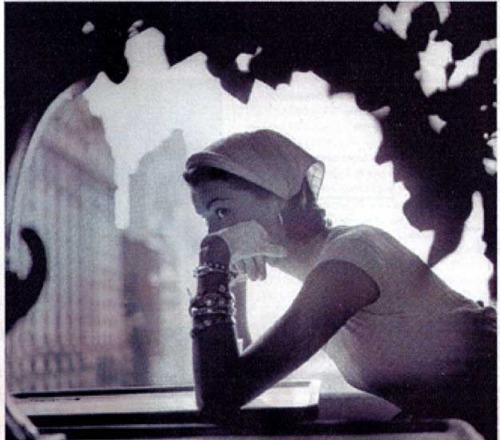


 Gordon Parks (1912-2006) was an American photographer, film director, writer and composer. He directed “Shaft” (1971) and co-founded Essence magazine. He was the first black photographer at Life magazine. He was the first black director at any big Hollywood studio. He was muse to Gloria Vanderbilt and godfather to one of Malcolm X’s children. He has at least three schools named after him.
He took pictures for Life magazine from 1948 to 1968, then the top weekly photojournalism magazine in America. He was big on two sorts of photography: high fashion and the photo essay. In the 1950s he helped Life’s white middle-class readers to see the injustice of Jim Crow; in the 1960s he helped them to understand why blacks were so angry.
He was the 15th child of a poor dirt farmer in Kansas. He was born dead. His namesake, Dr Gordon, got his heart started by putting him in ice-cold water.
At high school a white teacher told him a university education would be a waste – he would never be more than a porter. He dropped out of high school and later became a porter.
In 1937 when he was a waiter on the train from Chicago to Seattle he looked at a magazine left on the train, at an article on migrant workers:
I saw that the camera could be a weapon against poverty, against racism, against all sorts of social wrongs. I knew at that point I had to have a camera.
At Seattle he bought a second-hand camera. He did not even know how to load the film! But ten years later he was the only black photographer at Vogue! Along the way the photographers who took those pictures of the migrant workers trained him. They told him you cannot take a picture of a bigot and write “bigot” under the picture. The picture itself must show the bigotry.
Among his qualities:
- He could quickly gain the trust of people, from Ingrid Bergman to Elijah Mohammed to Life magazine to the Black Panthers to Warner Brothers to, most important of all, the people he took pictures of.
- He took sky-blue chances: he taught himself photography, composed music, followed a gang leader, tried to get hired at companies that would not even hire blacks as cleaning people, etc.
- Love of art and beauty: Even as a waiter he went to art museums. That art would later inform his photography.
- Anger at racism and poverty.
For example: Millions of white photographers wanted to work for Life. He knew he would never get an interview. So instead he just walked into the office of the editor and talked him into looking at his pictures!
He was careful not to let racism limit him. Yet it was not till he worked in Paris for Life that he fully understood how American racism had kept him from flowering. It was then that he spread his wings beyond photography and, in time, became a composer, writer and film director.
See also:

 Abagond
I had never heard of him Abagond. He is fantastic! Thanks for the intro. =)
LikeLike
Brilliant post!
LikeLike
Very informative post. Gordan Parks authored an autobiography, The Learning Tree. There is also a film adaptation of The Learning Tree.
dbg
LikeLike
Wow.. a lot of his photos were insanely beautiful. I really enjoyed 20, 22, & 23. Picture 28, captioned: “The Negro in the Cities, The Cry That Will Be Heard” gave me chills. Thank you for bringing such a great talent to our attention.
LikeLike
I heard and read about him once in a magazine. It was either “Time” or “Life”. He was a talented photographer.
LikeLike
Nice pictures! Much respect!
LikeLike
Mr. Parks captured the setting and overall scene of those moments in time. For example, the images of two very stark and separate drinking fountains/entrances with identifying signs. His photographs displayed the unfabricated truth of the world around us.
LikeLike
Those photos are brilliant.
LikeLike
I never knew he shot “The Cry…”
What a brilliant photographer.
LikeLike
Gordan Parks, great individual
Didnt he work with Malcolm X on his auto biography?
LikeLike
Amazing story of an amazing person. It’s really sad that I only heard of him and what he has done recently.
LikeLike
I’m surprised that so many people are just learning about Parks and his legacy. He was truly one of the great American artists of the 20th Century. People speak of Warhol and Pollock as if they were gods, but Parks scarcely gets a nod in terms of how he shaped mid-century culture.
Abagond, you probably could have done this post with no words at all, and it would have been just as powerful.
LikeLike
wow
LikeLike
Abagond, Thank you so much for writing this post. I absolutely love Gordon Parks’ work. Have you seen “The Learning Tree”? It’s based on his novel by the same name, which is based on his life. You really threw me curve ball when you put this up. Tiffany Pollard then BANG… Gordon Parks! Your blog is the first thing i do when I get to work in the morning. It gets me prepared for the day ahead. The breadth of your posts is amazing. Thanks again Abagond.
LikeLike
I remember Gordon Parks, and I remember reading his biography and the seeing the subsequent movie. Gordon Parks demonstrates how so many of our past geniuses were autodidacts, because of the limited opportunities available to them
LikeLike
@ The Cynic
Me too. Life magazine thought otherwise and did NOT print them.
Well, there is a book there: the pictures of Gordon Parks that Life magazine did not print because they were a white magazine and would only go so far.
LikeLike
@ Claude Jordan
I did that on purpose – but I have wanted to do a post on him for a long time. I have heard of “The Learning Tree” but have not read or seen it. Yet.
LikeLike
I am a bit surprised he is not better known. The 100th anniversary of his birth is coming up on November 30th so you will probably hear more and more of him in the coming months. It will be interesting to see if Google gives him a logo on his birthday.
LikeLike
Thank you for this beautiful and informative post. The depth and breadth of his talent and determination and sense of justice are stunning.
Google should mark his birthday, but I’m not holding my breath.
LikeLike
What beautiful work!! I was not aware of him before and his legacy. Some of the works are breathtakingly beautiful!
LikeLike
Very haunting images of the past…I love all things vintage and photography is no exception. Thanks for this post, Abagond!
I’m struck by the photos of the Black women with their children. Despite the racism of the times, they still managed to look so dignified and lovely in their shift dresses and high heels.
Simply gorgeous work.
LikeLike
[…] Gordon Parks (1912-2006) was an American photographer, film director, writer and composer. "I saw that the camera could be a weapon against poverty, against racism, against all sorts of social wrongs. I knew at that point I had to have a camera." -Gordon Parks […]
LikeLike
[…] on abagond.wordpress.com Rate this:Share this:TwitterFacebookPinterestTumblrMoreStumbleUponLinkedInRedditDiggEmailPrintLike […]
LikeLike
So this is the man behind those iconic images; Some of them are very familiar. Can you imagine looking through his portfolio? Your mouth will be catching flies!
One photograph really does say a thousand words
LikeLike
I usually chastise photographers for not being Real artists and simply clicking a button, but the images that Mr Parks captured takes a certain skill and passion that can easily rival the Picasso’s and Da Vinci’s of this world
LikeLike
@Bulanik
thanks for the Ernest Cole links. I hadn’t heard of him. When it comes to South Africa and Apartheid I usually never comment or get into conversations about it; My anger at the inhumanity just mutes me. Those photographs are really important.
A Protest song can only go so far
LikeLike
These pictures are indeed an education and a glimpse into our collective american soul; Parks was a master. Thanks so much to all y’all for the links you’ve shared, too!
Abagond, you rock like an avalanche. :~)
LikeLike
Gordon Parks was born 100 years ago today!!! (Not honoured by Google.)
LikeLiked by 1 person
100! These photos are amazing. He was talented. I’m not surprise Google would not recognize Gordon Parks. Glad you did.
LikeLike
Reblogged this on Lateral Love Australia and commented:
He was careful not to let racism limit him. Yet it was not till he worked in Paris for Life that he fully understood how American racism had kept him from flowering. It was then that he spread his wings beyond photography and, in time, became a composer, writer and film director.
LikeLike
[…] Gordon Parks. […]
LikeLike
That is so inspiring and his photos are amazing. I’ve reposted on Transitionstande
LikeLike
I am ashamed to say I had never heard of him although I had seen his photos (and, of course, seen Shaft).
Amazing.
Thanks for this.
LikeLike
Very cool! I like his photos! And he directed Shaft, eh? I’ve learned a little bit today. 🙂 Thx!
LikeLike
My dear Abagond…Thank you so-o-o-o much for this! I grew up with the photography of Gordon Parks in Life (it was bigger than the rest of the magazines!). I grew up with those “white only”/”colored only” lines of demarcation at the movies (we had to sit in the balcony in the white theaters), at public restrooms (in public places like Francis Marion Square downtown!); I grew up with those beautiful, Black women who, more often than not, MADE those beautiful outfits (from memory, or a Simplicity pattern) because they certainly couldn’t afford to buy them from the store (my Mama could lay you out for Easter — for just the price of the cloth from Edward’s five & dime!).
The photo of the little girl and her Mama looking in the store window made me catch my breath. I cannot tell you the number of times my Mama and I made that walk down King St. in Charleston. And though she couldn’t buy the dresses — she assured me she could make them — and she did, and nobody ever knew they weren’t store-bought!
@ Bulanik…Though I knew of Ernest Cole and Sam Nzima’s iconic, apartheid-era photo, thanks for all the links! You said:
“For some reason, photo 26, of the black nanny holding the white baby, with a well-dressed white woman to the side (perhaps the child’s mother?), made me pause a long while. The servitude portrayed disturbs me the most for a couple of reasons.
It was, more than likely the child’s mother, but I did not see “servitude” in that Black woman’s face at all ( art is, after all, one’s interpretation, based on lived experience, IMHO). What I saw was simmering, righteous indignation – not at the child she held, but the situation that made the holding necessary (in front of a camera lens no less!).
Abagond, you honor Mr. Parks most beautifully with this post. There’s nothing I love more than US, proudly telling our own stories! Thank you again…
LikeLiked by 1 person
Reblogged this on shafiqah1 and commented:
I am a huge Gordon Parks Fan 😀 #Alwayswillbe
LikeLike
a picture does indeed worth more than a thousand words.
LikeLike
Mr Abagond thank you in deed for this wonderfull and in depth work about Mr Gordon parks.
I am French west indian, I don’t even remember how I got to you. But let me tell you Mr Abagond “hat down”.
I have never heard of this man before. As someone said, we know about Warhol? Basquiat but nothing about Gordon Parks.
I am amazed to found out that he was cofounder of Essence magazine. My sister and I have been assiduous readers of Essence magazine.
Parks What is sad is that Mr Parks,had listened to what the white teacher told him “it’s a waste to go to university” and became a porter.
Fortunately for him he saw this magazine.
His work is a masterpiece, those photos are part of black history.
Thank you again Mr Abagond, and let me tell you that from now on I’ll be talking about Mr Gordon Parks to everybody.
One of my acquaintances is a white photographer and was even teacher in photography at the university in Paris; I’ll be introducing Mr Gordon Parks to him when dealing with the work of renowned photographer.
LikeLike
[…] Gordon Parks: African American photographer famous for his pictures of America in the 1950s and ’60s. (Abagond article) […]
LikeLike
@Bulanik…I apologize for my misinterpretation of your comment (a knee-jerk reaction to “my familiar,” no doubt), I’ll do better “listening” next time! Glad to hear you saw it too though.
Thanks for that great link and yes, that Herron photo was enraging and, as you said — it does just say everything about these alleged United States, both then and still! {smdh}. I spent some time this morning perusing the Iconic Photos site and not only did I appreciate all the photos, I learned quite a bit I didn’t know from the posts as well! Thank you for that…
LikeLike
I am so pleased to have found this posting. Gordon Parks and his work will live on as sources of beauty and truth that we must never, ever forget.
Thank you so much!
LikeLike